Aberrant Right Subclavian Artery as Incidental Finding and Associated to Dysphagia. A series of Cases and Review of the Literature
DOI:
https://doi.org/10.59667/sjoranm.v31i1.14Keywords:
Arteria lusoria, Computed Tomography, Incidental, Surgical, Implications, DysphagiaAbstract
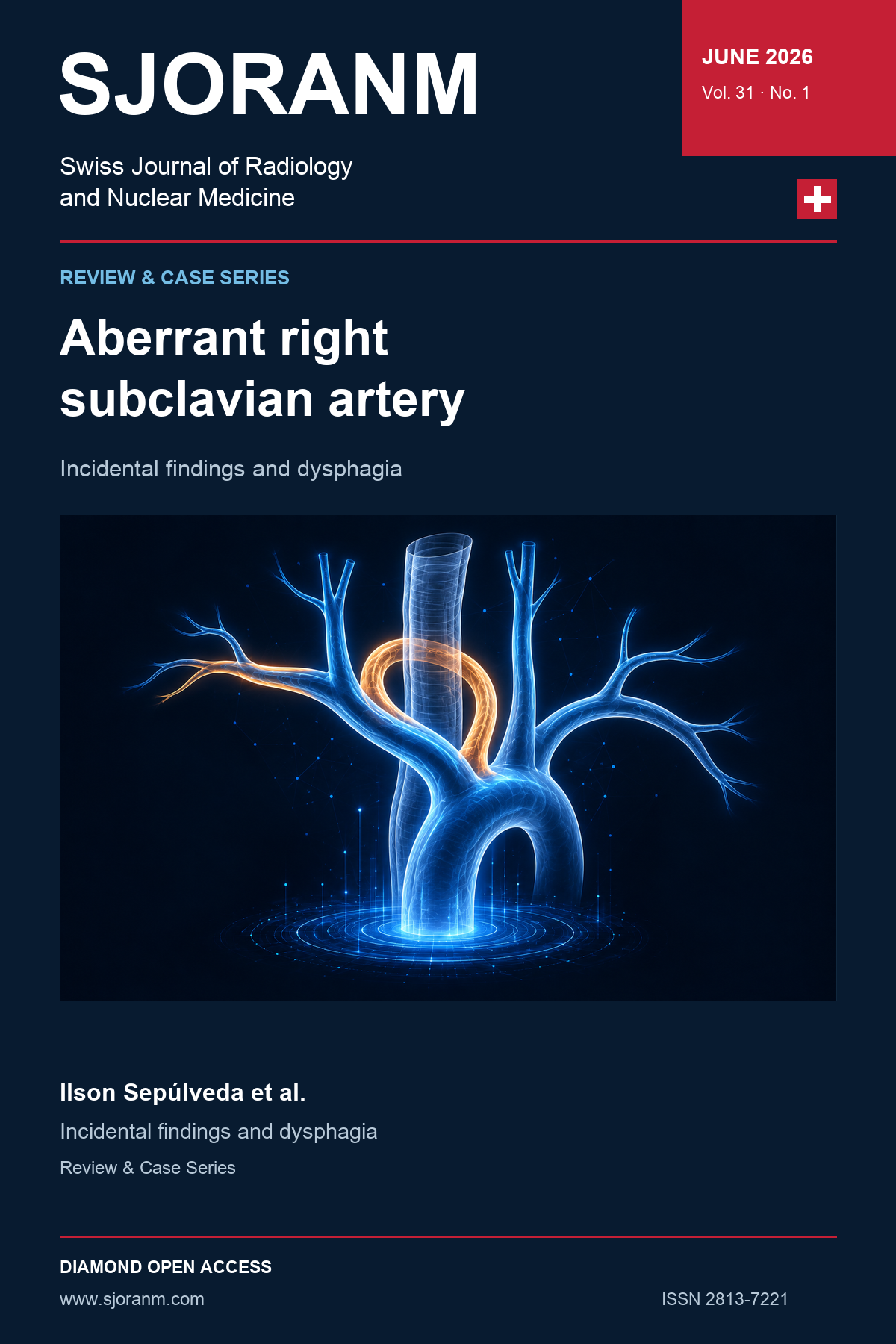
The Aberrant right subclavian artery (ARSA), also known as the "arteria lusoria," is a distinctive congenital anomaly of the aortic arch. Its estimated prevalence in the general population ranges from 0.16% to 4.4%, with a higher incidence in women. Many people remain asymptomatic throughout their lives, and the anomaly is usually discovered incidentally during imaging studies. The symptoms typically present as non-progressive mechanical dysphagia, primarily with solid foods, and usually appear around the fifth decade of life. Computed tomography angiography (CTA) is an invaluable tool for identifying the anomalous origin, its retroesophageal course, and the degree of esophageal compression. In addition to anatomical imaging studies, functional esophageal studies are gaining recognition for their role in evaluating dysphagia and distinguishing between true pathological compression and incidental findings. We present a series of four clinical cases of an anomalous right subclavian artery, either alone or associated with dysphagia, incidentally diagnosed in adult patients by CT. Our objective is to perform a thorough literature review to thoroughly analyze the implications and significance of this vascular anomaly, with a focus on its relevance in cases of dysphagia or dyspnea and its application to patients scheduled for surgical procedures in the chest and neck regions.
References
1. Castellano, B., Kumar, R., Buencamino, M., Sibaja, K., & Biglione, A. (2025). Arteria Lusoria: An Unusual Cause of Dysphagia. Cureus, 17(3), e81092. https://doi.org/10.7759/cureus.81092 DOI: https://doi.org/10.7759/cureus.81092
2. Laingonirina, D. H. H., Rakotozafindrabe, A. L. R., Razafindrazoto, C. I., et al. (2021). Arteria lusoria: A rare cause of chronic dysphagia. Clinical Case Reports, 9(12), e04895. https://doi.org/10.1002/ccr3.4895
3. Arakoni, R., Sriraj, R., Gupta, S., & Bapna, H. (2018). Foreign body sensation: A rare case of dysphagia lusoria in a healthy female. American Journal of Emergency Medicine. DOI: 10.1016/j.ajem.2018.08.029. DOI: https://doi.org/10.1016/j.ajem.2018.08.029
4. Polguj, M., Chrzanowski, Ł., Kasprzak, J. D., et al. (2014). The aberrant right subclavian artery (arteria lusoria): the morphological and clinical aspects of one of the most important variations—a systematic study of 141 reports. Scientific World Journal, 2014, 292734. https://doi.org/10.1155/2014/292734 DOI: https://doi.org/10.1155/2014/292734
5. Myers, P. O., Fasel, J. H., Kalangos, A., & Gailloud, P. (2010). Arteria lusoria: developmental anatomy, clinical, radiological and surgical aspects. Annales de Cardiologie et d'Angéiologie, 59(3), 147–154. https://doi.org/10.1016/j.ancard. DOI: https://doi.org/10.1016/j.ancard.2009.07.008
6. Janssen, M., Baggen, M. G., Veen, H. F., Smout, A. J., Bekkers, J. A., Jonkman, J. G., & Ouwendijk, R. J. (2000). Dysphagia lusoria: clinical aspects, manometric findings, diagnosis, and therapy. The American journal of gastroenterology, 95(6), 1411–1416. https://doi.org/10.1111/j.1572-0241.2000.02071.x DOI: https://doi.org/10.1111/j.1572-0241.2000.02071.x
7. Wellington, J., Kim, J., Castell, D. O., & Xie, G. (2021). Dysphagia lusoria: utility of high-resolution impedance manometry to identify true disease. Neurogastroenterology and motility, 33(9), e14176. https://doi.org/10.1111/nmo.14176 DOI: https://doi.org/10.1111/nmo.14176
8. van Rosendael, P. J., Stöger, J. L., Kiès, P., Vliegen, H. W., Hazekamp, M. G., Koolbergen, D. R., Lamb, H. J., Jongbloed, M. R. M., & Egorova, A. D. (2021). The Clinical Spectrum of Kommerell’s Diverticulum in Adults with a Right-Sided Aortic Arch: A Case Series and Literature Overview. Journal of Cardiovascular Development and Disease, 8(3), 25. https://doi.org/10.3390/jcdd8030025 DOI: https://doi.org/10.3390/jcdd8030025
9. Epperson, M. V., & Howell, R. (2019). Dysphagia lusoria: problem or incidentaloma?. Current Opinion in Otolaryngology & Head and Neck Surgery, 27(6), 448–452. https://doi.org/10.1097/MOO.0000000000000583 DOI: https://doi.org/10.1097/MOO.0000000000000583
10. Lee, M. J., Chae, K. B., & Kim, M. S. (2018). Right Subclavian Artery With Kommerell’s Diverticulum: A Rare Cause of Dysphagia. Annals of Thoracic and Cardiovascular Surgery, 24(1), 58–61. https://doi.org/10.5761/atcs.cr.17-00045
11. Rozenberg, J., Mir, A., & Birkman, J. (2025). Dysphagia due to an Aberrant Right Subclavian Artery: Dysphagia Lusoria. Gastro hep advances, 4(6), 100626. https://doi.org/10.1016/j.gastha.2025.100626 DOI: https://doi.org/10.1016/j.gastha.2025.100626
12. Hasina Laingonirina, D. H., Rakotozafindrabe, A. L. R., Razafindrazoto, C. I., Rajaonarison, L. H. N. O. N., Randriamifidy, N. H., Rabenjanahary, T. H., Razafimahefa, S. H., & Ramanampamonjy, R. M. (2021). Arteria lusoria: A rare cause of chronic dysphagia. Clinical case reports, 9(10), e04895. https://doi.org/10.1002/ccr3.4895 DOI: https://doi.org/10.1002/ccr3.4895
13. Zapata, H., Edwards, J. E., & Titus, J. L. (1993). Aberrant right subclavian artery with left aortic arch: Associated cardiac anomalies. Pediatric Cardiology, 14(3), 159–161. https://doi.org/10.1007/bf00795415 DOI: https://doi.org/10.1007/BF00795645
14. Erben, Y., Brownstein, A. J., Velasquez, C. A., Li, Y., Rizzo, J. A., Mojibian, H., Tanweer, M., Zafar, M. A., Ziganshin, B. A., & Elefteriades, J. A. (2020). Natural history and management of Kommerell's diverticulum in a single tertiary referral center. Journal of vascular surgery, 71(6), 2004–2011. https://doi.org/10.1016/j.jvs.2019.08.260 DOI: https://doi.org/10.1016/j.jvs.2019.08.260
15. Alper, F., Akgun, M., Kantarci, M., Eroglu, A., Ceyhan, E., Onbas, O., Duran, C., & Okur, A. (2006). Demonstration of vascular abnormalities compressing esophagus by MDCT: special focus on dysphagia lusoria. European journal of radiology, 59(1), 82–87. https://doi.org/10.1016/j.ejrad.2006.01.013 DOI: https://doi.org/10.1016/j.ejrad.2006.01.013
16. De Luca, L., Bergman, J. J., Tytgat, G. N., & Fockens, P. (2000). EUS imaging of the arteria lusoria: case series and review. Gastrointestinal endoscopy, 52(5), 670–673. https://doi.org/10.1067/mge.2000.109808 DOI: https://doi.org/10.1067/mge.2000.109808
17. Paparo, F., Bacigalupo, L., Melani, E., Rollandi, G. A., & Caro, G. D. (2012). Cardiac-MRI demonstration of the ligamentum arteriosum in a case of right aortic arch with aberrant left subclavian artery. World journal of radiology, 4(5), 231–235. https://doi.org/10.4329/wjr.v4.i5.231 DOI: https://doi.org/10.4329/wjr.v4.i5.231
18. American College of Gastroenterology. (2022). ACG Clinical Guidelines: Clinical Use of Esophageal Physiologic Testing. The American Journal of Gastroenterology, 117(3), 365–381. https://doi.org/10.14309/ajg.0000000000001614 DOI: https://doi.org/10.14309/ajg.0000000000001614
19. Lazarescu, A., Chan, W. W., Gyawali, C. P., Lee, Y. Y., Xiao, Y., & Wu, P. (2020). Updates on diagnostic modalities for esophageal dysphagia. Annals of the New York Academy of Sciences, 1481(1), 108–116. https://doi.org/10.1111/nyas.14453 DOI: https://doi.org/10.1111/nyas.14453
20. Tsukui, H., Aomi, S., & Yamazaki, K. (2014). Surgical strategy for Kommerell's diverticulum: total arch replacement. The Journal of thoracic and cardiovascular surgery, 148(4), 1423–1427. https://doi.org/10.1016/j.jtcvs.2013.11.026 DOI: https://doi.org/10.1016/j.jtcvs.2013.11.026
21. Loschi, D., Santoro, A., Rinaldi, E., Bilman, V., Chiesa, R., & Melissano, G. (2023). A systematic review of open, hybrid, and endovascular repair of aberrant subclavian artery and Kommerell's diverticulum treatment. Journal of vascular surgery, 77(2), 642–649.e4. https://doi.org/10.1016/j.jvs.2022.07.010 DOI: https://doi.org/10.1016/j.jvs.2022.07.010
22. Tsukube, T., Ataka, K., Sakata, M., Wakita, N., & Okita, Y. (2001). Surgical treatment of an aneurysm in the right aortic arch with aberrant left subclavian artery. The Annals of thoracic surgery, 71(5), 1710–1711. https://doi.org/10.1016/s0003-4975(00)02698-9 DOI: https://doi.org/10.1016/S0003-4975(00)02698-9
23. Fan, W., Tan, J., Shi, W., Rong, J., & Yu, B. (2021). A Systematic Review of Total Thoracic Endovascular Aortic Repair in Treatment of Kommerell Diverticulum Combined with Right-Sided Aortic Arch. Medical science monitor : international medical journal of experimental and clinical research, 27, e930031. https://doi.org/10.12659/MSM.930031 DOI: https://doi.org/10.12659/MSM.930031
24. Fukuhara, S., Ahmed, Y., Shiomi, S., Yang, B., Kim, K. M., Deeb, G. M., Williams, D., & Patel, H. J. (2022). Aberrant Subclavian Arteries and Associated Kommerell Diverticulum: Endovascular vs Open Repair. The Annals of thoracic surgery, 114(6), 2163–2171. https://doi.org/10.1016/j.athoracsur.2021.09.065 DOI: https://doi.org/10.1016/j.athoracsur.2021.09.065
25. Gray, S. E., Scali, S. T., Feezor, R. J., Beaver, T. M., Back, M. R., Upchurch, G. R., Jr, Huber, T. S., & Fatima, J. (2020). Safety and efficacy of a hybrid approach for repair of complicated aberrant subclavian arteries. Journal of vascular surgery, 72(6), 1873–1882. https://doi.org/10.1016/j.jvs.2020.01.075 DOI: https://doi.org/10.1016/j.jvs.2020.01.075
26. Chu, N. Q., Chow, O. S., Nguyen, H. S., Villena-Vargas, J., Harrison, S., Mack, C., Port, J., Altorki, N., & Lee, B. (2024). Staged, robotic video-assisted thoracoscopic surgical approach to treat dysphagia lusoria. JTCVS techniques, 27, 169–171. https://doi.org/10.1016/j.xjtc.2024.07.024 DOI: https://doi.org/10.1016/j.xjtc.2024.07.024
Downloads
Published
Data Availability Statement
Data are available from the authors on reasonable request.
Issue
Section
License
Copyright (c) 2026 Ilson Sepúlveda, Arístides A. Capizzano, Francisco Rivas-Rodriguez, Sergio Castillo

This work is licensed under a Creative Commons Attribution 4.0 International License.
This license requires that reusers give credit to the creator. It allows reusers to distribute, remix, adapt, and build upon the material in any medium or format, even for commercial purposes.
 LinkedIn ↗
 X ↗
X ↗ VK ↗
VK ↗ Truth Social ↗
 Bluesky ↗
 YouTube ↗