The Nutcracker-like Phenomenon Secondary to Severe Scoliosis
A Case Report
DOI:
https://doi.org/10.59667/sjoranm.v28i1.16Keywords:
scoliosis, nutcracker, gastroduodenal artery, superior mesenteric artery, renal veinAbstract
Introduction:
Nutcracker syndrome refers to symptomatic compression of the left renal vein, most commonly between the aorta and the superior mesenteric artery, while the term nutcracker phenomenon is reserved for asymptomatic cases. Owing to non-specific clinical manifestations, the condition is frequently underdiagnosed and often identified incidentally on imaging. We report a novel cause of nutcracker phenomenon related to severe scoliosis.
Case Report:
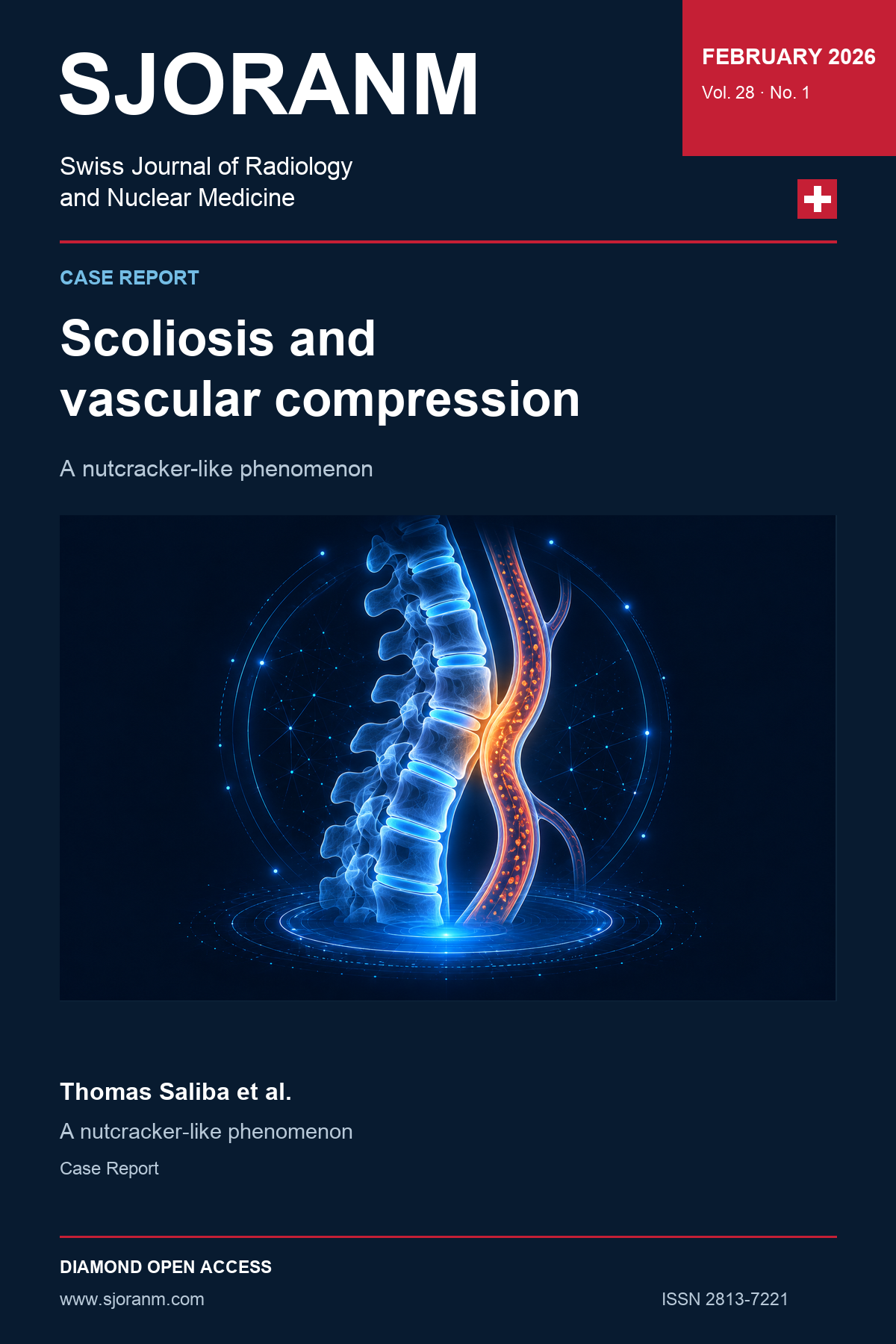
A 65-year-old woman presented with transient visual disturbances and speech difficulties, prompting brain MRI for suspected stroke. While no ischemic lesions were identified, angiographic sequences revealed a small right subclavian aneurysm, leading to further thoracoabdominal CT evaluation. CT demonstrated severe scoliosis with marked displacement of abdominal vascular structures. The gastroduodenal artery and portal vein were displaced inferiorly and found to compress the left renal vein. Associated dilatation of the proximal left renal vein and left ovarian vein indicated increased venous pressure. As the patient was asymptomatic, a diagnosis of nutcracker phenomenon was made, and no specific treatment was initiated.
Discussion:
Although numerous anatomical variants causing left renal vein compression have been described, this represents the first reported case of nutcracker-like phenomenon secondary to scoliosis-induced vascular distortion involving the gastroduodenal artery and portal vein.
Conclusion:
Severe spinal deformities can result in atypical vascular compression syndromes. Awareness of such mechanisms is important when interpreting cross-sectional imaging, particularly in asymptomatic patients with incidental venous findings.
References
Ananthan, K., Onida, S., & Davies, A. H. (2017). Nutcracker Syndrome: An Update on Current Diagnostic Criteria and Management Guidelines. In European Journal of Vascular and Endovascular Surgery (Vol. 53, Issue 6, pp. 886–894). W.B. Saunders Ltd. https://doi.org/10.1016/j.ejvs.2017.02.015
Berz, A., Sartoretti, T., Hajri, R., & Fahrni, G. (2025). Incidental Finding of a Retroaortic Left Renal Vein with Pelvic Venous Congestion Consistent with Posterior Nutcracker Syndrome: A Case Report. Journal of Radiology Case Reports, 19(12). https://doi.org/10.3941/JRCR.5888
de Schepper, A. (1972). ["Nutcracker" phenomenon of the renal vein and venous pathology of the left kidney]. Journal Belge de Radiologie, 55(5), 507–511.
Er, A., Uzunlulu, N., Guzelbey, T., Yavuz, S., Kiyak, A., & Kayhan, A. (2019). The nutcracker syndrome: The usefulness of different MRI sequences for diagnosis and follow-up. Clinical Imaging, 55, 144–147. https://doi.org/10.1016/j.clinimag.2019.02.003
Gulleroglu, K., Gulleroglu, B., & Baskin, E. (2014). Nutcracker syndrome. World Journal of Nephrology, 3(4), 277. https://doi.org/10.5527/wjn.v3.i4.277
Kalantar, D. S., Park, S. J., & Shin, J. Il. (2023). Nutcracker syndrome in children: review of symptom, diagnosis, and treatment. Childhood Kidney Diseases, 27(2), 89–96. https://doi.org/10.3339/CKD.23.018
Kim, S. H. (2022). Radiology Illustrated: Nutcracker Phenomenon and Nutcracker Syndrome. Springer Nature Singapore. https://doi.org/10.1007/978-981-16-6218-8
Kolber, M. K., Cui, Z., Chen, C. K., Habibollahi, P., & Kalva, S. P. (2021). Nutcracker syndrome: diagnosis and therapy. Cardiovascular Diagnosis and Therapy, 11(5), 1140–1149. https://doi.org/10.21037/cdt-20-160
Kurklinsky, A. K., & Rooke, T. W. (2010). Nutcracker phenomenon and nutcracker syndrome. In Mayo Clinic Proceedings (Vol. 85, Issue 6, pp. 552–559). Elsevier Ltd. https://doi.org/10.4065/mcp.2009.0586
M., O., K., T., & S., I. (1998). Diagnosis of the nutcracker phenomenon using two-dimensional ultrasonography. Clinical Nephrology. https://www.scopus.com/pages/publications/0031983295?inward=
Mniai, E. M., Sadafyine, Y. B., Benfaida, A., Mahi, M., Rami, A., Mniai, E. M., Benhayoun, Y., Benfaida, A., Mahi, M., & Rami, A. (2022). Fortuitous Discovery of Nutcracker Syndrome During Acute Appendicitis: A Case Report. Cureus, 14(12). https://doi.org/10.7759/CUREUS.32109
Penfold, D., Leslie, S. W., & Lotfollahzadeh, S. (2025). Nutcracker Syndrome and Left Renal Vein Entrapment. In StatPearls. http://www.ncbi.nlm.nih.gov/pubmed/25374822
Shin, J. I., Lee, J. S., & Kim, M. J. (2006). The Prevalence, Physical Characteristics and Diagnosis of Nutcracker Syndrome. European Journal of Vascular and Endovascular Surgery, 32(3), 335–336. https://doi.org/10.1016/J.EJVS.2006.04.030
Downloads
Published
Data Availability Statement
No data were created when writing this manuscript.
Issue
Section
License
Copyright (c) 2026 Thomas Saliba, Simon Leboube, Guillaume Fahrni

This work is licensed under a Creative Commons Attribution 4.0 International License.
This license requires that reusers give credit to the creator. It allows reusers to distribute, remix, adapt, and build upon the material in any medium or format, even for commercial purposes.