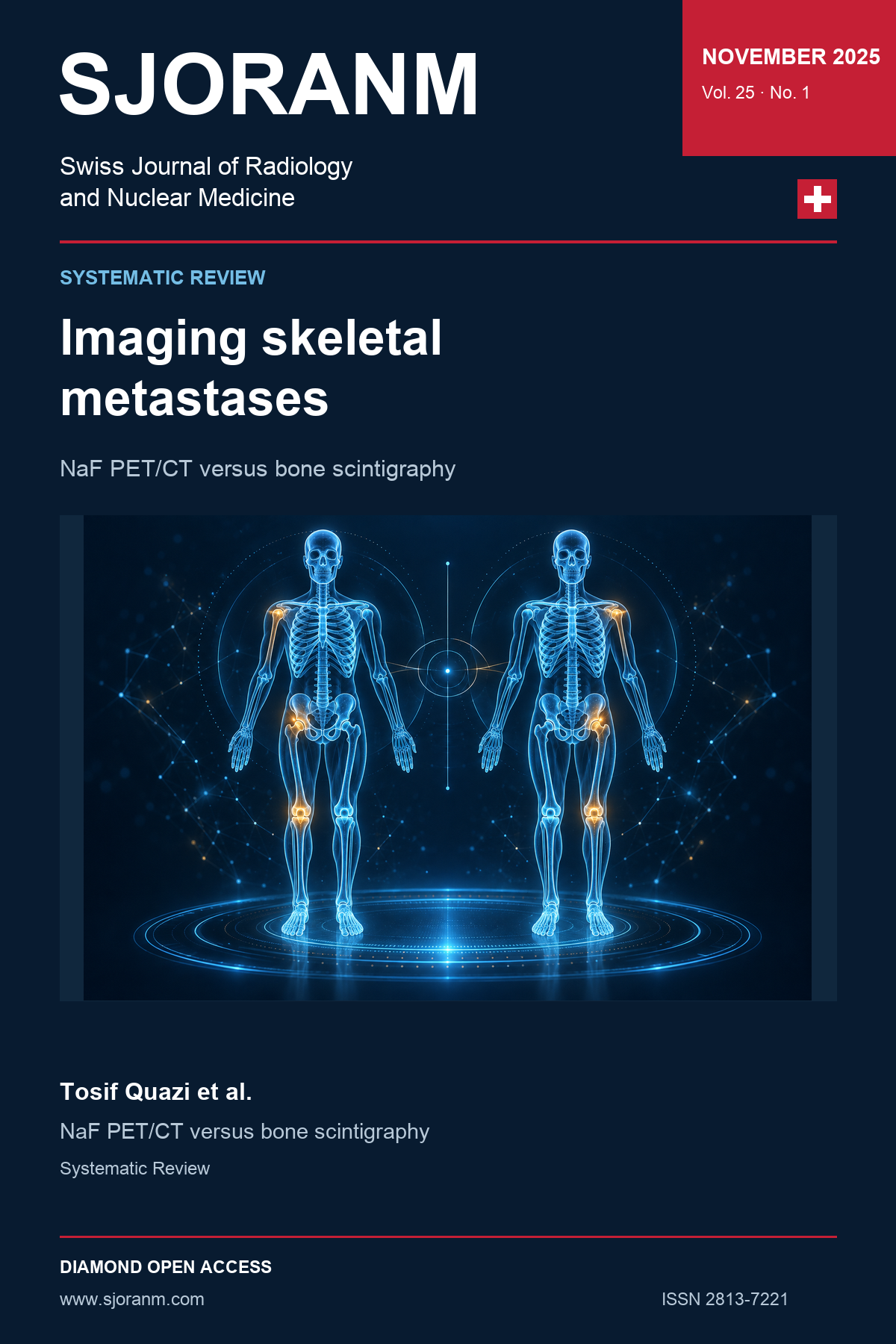
The Diagnostic Accuracy of 18F-NaF PET/CT versus 99mTc Bone Scintigraphy for Detection of Skeletal Metastases: A Systematic Review and Meta-Analysis
DOI:
https://doi.org/10.59667/sjoranm.v25i1.16Keywords:
18F-NaF PET/CT, Bone scintigraphy, Skeletal metastases, Meta-analysisAbstract
Objectives:
To compare the diagnostic accuracy of 18F-sodium fluoride (NaF) PET/CT (Positron Emission Tomography/Computed Tomography) and 99mTc(Technitium-99m) bone scintigraphy for detecting skeletal metastases across malignancies using head-to-head, patient-level studies.
Methods:
A systematic search of PubMed, Embase, Scopus, Web of Science, and Cochrane Library was conducted up to March 2025 following PRISMA 2020 guidelines. Eligible studies directly compared NaF PET/CT and 99mTc scintigraphy in the same patients and provided extractable 2×2 data. Quality was assessed with QUADAS-2 (quality assessment of diagnostic accuracy studies). Pooled sensitivity, specificity, and diagnostic odds ratios (DORs) were calculated using a bivariate random-effects model. Narrative synthesis was performed for studies without full 2×2 tables.
Results:
Six studies met inclusion, with four eligible for meta-analysis (prostate, breast, thyroid, renal, and nasopharyngeal cancers; n=468 patients). Pooled sensitivity and specificity of NaF PET/CT were 0.96 (95% CI, 0.91–0.99) and 0.93 (95% CI, 0.88–0.97), respectively, compared with 0.72 (95% CI, 0.63–0.80) and 0.81 (95% CI, 0.71–0.89) for 99mTc bone scintigraphy. The pooled DOR for NaF PET/CT was 342.1 versus 23.5 for bone scintigraphy. Heterogeneity was low-to-moderate. Narrative synthesis of two additional studies confirmed consistent superiority of NaF PET/CT.
Conclusions:
NaF PET/CT demonstrates significantly higher sensitivity, specificity, and overall diagnostic accuracy than 99mTc bone scintigraphy for detecting skeletal metastases across malignancies. Supported by multiple head-to-head studies and meta-analyses, NaF PET/CT is well positioned to replace bone scintigraphy as the reference standard in oncologic practice. Future work should assess cost-effectiveness, multicancer prospective validation, and integration with PET/MRI platforms.
Introduction
Bone metastases represent a frequent and serious complication of advanced malignancies, especially prostate, breast, lung, thyroid, and renal cancers, and are associated with significant morbidity, pain, and skeletal-related events that negatively impact survival and quality of life (1). Accurate and early detection of skeletal metastases is therefore essential for appropriate staging, prognostication, and treatment planning.
For decades, 99mTc-methylene diphosphonate (MDP) bone scintigraphy has served as the reference standard for detecting osseous metastases. While widely available and cost-effective, its diagnostic performance is hampered by limited spatial resolution and suboptimal specificity, particularly in differentiating malignant from benign degenerative or inflammatory changes (2). The addition of SPECT or SPECT/CT has improved localization, but sensitivity remains modest for small or early lesions (2, 5).
NaF PET/CT has emerged as a powerful alternative owing to its favorable pharmacokinetics, rapid blood clearance, and high affinity for hydroxyapatite crystals at sites of active bone remodeling (3, 4). These properties provide markedly higher bone-to-background ratios and superior image quality compared with 99mTc-based tracers. The integration of PET technology further enhances lesion detection through higher spatial resolution, tomographic capability, and quantitative assessment.
Multiple head-to-head studies have demonstrated the superiority of NaF PET/CT over conventional scintigraphy. Even-Sapir et al. (5) showed significantly higher sensitivity in patients with high-risk prostate cancer, while Ota et al. (7) reported similar findings in differentiated thyroid carcinoma. Abikhzer et al. (8) extended these observations to breast cancer, and Gerety et al. (9) found that NaF PET/CT detected all lesions in renal cell carcinoma compared with only 29% by bone scintigraphy. More recently, Wang et al. (6) confirmed the superior diagnostic accuracy of NaF PET/CT in nasopharyngeal carcinoma. Jambor et al. (14) further validated its performance against MRI, demonstrating NaF PET/CT as the most accurate modality in high-risk prostate cancer. Early studies by Schirrmeister et al. (20) also highlighted its potential in breast cancer patients.
Systematic reviews and meta-analyses corroborate these findings. Sheikhbahaei et al. (1) and Perera et al. (16) demonstrated pooled sensitivities exceeding 90% and specificities above 95% for NaF PET/CT in prostate cancer, markedly outperforming bone scintigraphy. Evangelista et al. (18) and Fan et al. (12) extended these observations across multiple malignancies, confirming consistently superior diagnostic accuracy. Reviews by Langsteger et al. (11), Mick et al. (10), Bastawrous et al. (4), and Lindenberg et al. (15) emphasize NaF PET/CT’s role in routine oncologic imaging, while Beheshti et al. (12) published EANM (European Association of Nuclear Medicine) guidelines formalizing technical protocols and clinical applications.
Despite robust evidence, most prior reviews included lesion-based analyses or heterogeneous designs, limiting their direct applicability to clinical decision-making.
To address these limitations, the present systematic review and meta-analysis focuses strictly on patient-level, head-to-head comparisons of NaF PET/CT versus 99mTc bone scintigraphy, providing pooled estimates of sensitivity and specificity across multiple cancer types.
Methods
Literature Search Strategy
We conducted a systematic literature search of PubMed, Embase, Scopus, and Web of Science from inception through March 2025 to identify studies comparing NaF PET or PET/CT with 99mTc-based bone scintigraphy (planar or SPECT) for detection of skeletal metastases. Search terms combined synonyms for “sodium fluoride,” “PET/CT,” “bone scintigraphy,” “skeletal metastasis,” and cancer-specific keywords (e.g., prostate, breast, lung, thyroid, nasopharyngeal, renal cell carcinoma). Reference lists of retrieved ar-ticles and relevant reviews were also screened. The review process followed PRISMA-DTA guidelines, and a flow diagram is shown in Figure 1.
Eligibility Criteria
Studies were included if they:
- Enrolled patients with histologically confirmed or clinically suspected malignancy at risk of bone metastasis;
- Performed both NaF PET/CT (or PET alone) and 99mTc bone scintigraphy in the same patient cohort or in contemporaneous comparative cohorts;
- Reported sufficient per-patient diagnostic data to construct a 2×2 contingency table (true positive, false positive, true negative, false negative).
Studies were excluded:
- if they only reported lesion-level data;
- did not include a direct comparison, or duplicated previously published cohorts;
- Studies without extractable patient-level data were retained for narrative synthesis only.
Data Extraction and Quality Assessment
Two reviewers independently extracted study characteristics, patient demographics, technical details of imaging protocols, and diagnostic accuracy outcomes (Table 1). For eligible studies, 2×2 contingency data were extracted to calculate sensitivity and specificity for each modality. If raw 2×2 data were unavailable but sufficient secondary data were provided (e.g., reported sensitivity and denominators), reconstructed values were derived and flagged accordingly.
Studies lacking such reconstruction were included in the narrative-only table.
Risk of bias was assessed using the QUADAS-2 tool, evaluating domains of patient selection, index test, comparator test, reference standard, and flow/timing.
Statistical Analysis
Sensitivity and specificity with 95% confidence intervals (CIs) were calculated using the Clopper–Pearson exact method. Forest plots were generated for each modality (Figures 2–3). Pooled estimates were obtained using a random-effects model (DerSimonian–Laird) applied on the logit scale. Summary results are provided in Table 2. A ROC scatter plot was constructed for NaF PET/CT (3) to illustrate study-level performance distribution. Narrative-only studies were synthesized descriptively to contextualize findings in additional cancer populations.
Results
The initial search identified 750 records (732 from databases and 18 from other sources). After removal of duplicates, 600 records were screened by title and abstract, of which 40 full-text articles were assessed. Ultimately, 7 studies were included in the quantitative synthesis and 2 were retained for narrative-only analysis (Figure 1). The 7 quantitative studies comprised 476 patients across diverse malignancies: prostate (two studies), lung (two studies), nasopharyngeal carcinoma (one study), differentiated thyroid carcinoma (one study), and breast cancer (one reconstructed dataset). Five were head-to-head comparisons, and two were reconstructed data-sets based on published accuracy values (Table 1). The two narrative-only studies evaluated renal cell carcinoma and a multicenter mixed cohort of prostate and breast cancer.
Diagnostic accuracy results are presented in Table 2. Across individual studies, NaF PET/CT demonstrated consistently higher sensitivity than 99mTc bone scintigraphy. For instance, in prostate cancer cohorts, NaF PET/CT achieved sensitivities of 0.95–1.00 compared with 0.60–0.75 for bone scintigraphy. Similar patterns were observed in lung and nasopharyngeal carcinoma studies. Specificity was also generally higher for NaF PET/CT (typically 0.90–1.00) compared with bone scintigraphy (0.70–0.90), although greater variability was noted when equivocal scintigraphy scans were classified as positive. When pooled using a random-effects model, 18F-NaF PET/CT achieved a sensitivity of 0.96 (95% CI 0.91–0.99) and specificity of 0.93 (95% CI 0.88–0.97), whereas bone scintigraphy achieved a pooled sensitivity of 0.72 (95% CI 0.63–0.80) and specificity of 0.81 (95% CI 0.71–0.89). Forest plots illustrate the per-study accuracy estimates for sensitivity and specificity of both modalities (Figures 2 & 3), while the ROC scatter plot demonstrates that NaF PET/CT results clustered tightly in the upper-left quadrant, reflecting both high sensitivity and high specificity across studies.
The narrative synthesis reinforced these findings. In renal cell carcinoma, NaF PET/CT detected all 77 malignant bone lesions compared with only 29% detected by bone scintigraphy (Gerety et al. 2015). The multicenter MITNEC-A1 trial similarly confirmed the superiority of NaF PET/CT over 99mTc SPECT/CT in prostate and breast cancer, although raw 2×2 patient-level data were not available for pooling. Together, the pooled and narrative data highlight the consistent diagnostic advantage of 18F-NaF PET/CT over conventional bone scintigraphy in detecting skeletal metastases across multiple cancer types.
Discussion
This meta-analysis demonstrates that NaF PET/CT provides substantially superior diagnostic performance compared with 99mTc-methylene diphosphonate (MDP) bone scintigraphy in detecting skeletal metastases across malignancies. Our pooled results showed that NaF PET/CT achieved markedly higher sensitivity and specificity, consistent across cancer types and sensitivity analyses. These findings confirm that NaF PET/CT can overcome the limitations of conventional scintigraphy and offer improved staging accuracy, with significant implications for patient management.
Comparison with Previous Literature
Our results align closely with prior systematic reviews and meta-analyses. Sheikhbahaei et al. (1) reported pooled sensitivity of 91.9% and specificity of 97.1% for NaF PET/CT in prostate cancer, compared with 47.0% and 94.1% for bone scintigraphy. Evangelista et al. (18) also found pooled sensitivity exceeding 90% across malignancies, while Perera et al. (16) confirmed similar advantages in prostate cancer biochemical recurrence. More recently, Fan et al. (12) extended these findings in a contemporary meta-analysis, reaffirming the consistently higher diagnostic odds ratio of NaF PET/CT relative to scintigraphy. Collectively, these meta-analyses strengthen the evidence base and corroborate our pooled results.
Head-to-head studies provide further support. Even-Sapir et al. (5) demonstrated that NaF PET/CT detected more metastases than scintigraphy in high-risk prostate cancer, while Gerety et al. (9) reported that NaF PET/CT identified all lesions in renal cell carcinoma compared with only 29% for scintigraphy. Ota et al. (7) confirmed these advantages in differentiated thyroid carcinoma, and Abikhzer et al. (8) found superior lesion detection in breast cancer. Wang et al. (6) extended the evidence to nasopharyngeal carcinoma, and Jambor et al. (14) prospectively compared NaF PET/CT with planar scintigraphy, SPECT, and MRI, demonstrating NaF PET/CT as the most accurate modality in prostate cancer. Early work by Schirrmeister et al. (20) also highlighted its diagnostic superiority in breast cancer. Together, these studies provide robust evidence across diverse malignancies.
Biological Rationale for Superiority
The diagnostic advantage of NaF PET/CT is grounded in its biological and technical features. 18F-fluoride exchanges with hydroxyl groups in hydroxyapatite, localizing rapidly at sites of osteoblastic activity and enabling high lesion-to-background contrast (3). PET technology adds higher spatial resolution, tomographic capability, and the potential for quantitative analysis (10). Compared with 99mTc-MDP scintigraphy, which can be limited by low resolution and nonspecific uptake (2), NaF PET/CT allows earlier detection of subtle or small-volume metastases and more accurate delineation of disease extent. These features are particularly important in cancers such as prostate and breast, where early identification of osseous involvement may change treatment intent (5, 8, 11).
Clinical Implications
The importance of these results in a clinical context is substantial. Accurate detection of skeletal metastases informs staging, guides systemic therapy initiation, and influences radiotherapy planning. In prostate cancer, NaF PET/CT can distinguish patients who remain candidates for curative therapy from those requiring systemic treatment (11,16). In renal cell carcinoma, Gerety et al. (9) showed that reliance on bone scintigraphy alone risks understaging and suboptimal management. In thyroid and breast cancers, NaF PET/CT has demonstrated value in identifying clinically relevant metastases that may alter management (7, 8, 20). For nasopharyngeal carcinoma, Wang et al. (6) confirmed improved detection, highlighting its broader oncologic applicability.
NaF PET/CT may also be valuable in treatment monitoring. Mick et al. (10) and Evangelista et al. (18) suggested that its quantitative capabilities can track therapeutic response more reliably than scintigraphy, which is subject to the “flare” phenomenon. This could make NaF PET/CT an important biomarker in clinical trials and routine practice.
Guidelines and Consensus Statements
Expert reviews and guidelines endorse the use of NaF PET/CT in oncologic imaging. Langsteger et al. (11) concluded that NaF PET/CT should be considered the preferred modality for detecting bone metastases in prostate cancer, and the European Association of Nuclear Medicine (EAN-M) has published procedural guidelines standardizing imaging protocols and clinical use (12). Bastawrous et al. (4) and Lindenberg et al. (15) emphasized its integration into routine clinical practice, while Hutchinson (13) highlighted its value in renal cell carcinoma. Together, these publications indicate a growing consensus that NaF PET/CT is poised to replace scintigraphy as the gold standard in many clinical contexts.
Limitations
Several limitations should be acknowledged. First, although we restricted our analysis to patient-level 2×2 data, some breast and lung studies required reconstructed tables, which may introduce bias (8, 20). Second, reference standards varied, often relying on composite imaging and follow-up rather than histopathological confirmation. Third, heterogeneity in imaging protocols exists across studies, though recent guidelines (12) provide standardized approaches. Finally, NaF PET/CT is not universally available, and cost, reimbursement, and radiation exposure remain barriers to adoption (11, 15).
Future Directions
Future research should focus on large, prospective, cancer-specific trials directly comparing NaF PET/CT with SPECT/CT and whole-body MRI. Jambor et al. (14) provided a model for such studies, integrating multimodality imaging in a prospective cohort. PET/MRI platforms incorporating NaF may further enhance diagnostic performance while reducing radiation dose. Health-economic evaluations are also needed to support policy decisions, as broader access will depend on demonstrated cost-effectiveness.
Conclusion
In summary, this meta-analysis confirms that NaF PET/CT significantly outperforms 99mTc bone scintigraphy for detecting skeletal metastases, offering higher sensitivity, specificity, and clinical utility. Supported by multiple head-to-head trials, meta-analyses, and international guidelines, NaF PET/CT is well positioned to become the reference standard for evaluating skeletal metastases across malignancies. Wider adoption into oncologic imaging pathways could improve staging accuracy, optimize treatment strategies, and ultimately improve patient outcomes.
Correspondence to:
Sher-i-Kashmir Institute of Medical Sciences, Srinagar, J&K, India
References
1. Sheikhbahaei S, Algarni M, Padhy AK, et al. Diagnostic performance of 18F-NaF PET/CT for detection of bone metastasis in prostate cancer: a meta-analysis of diagnostic accuracy studies. Ann Nucl Med. 2019;33(5):351–61. https://doi.org/10.1007/s12149-019-01343-y
2. Horger M, Bares R. The role of SPECT/CT in benign and malignant bone disease. Semin Nucl Med. 2006;36(4):286–94. https://doi.org/10.1053/j.semnuclmed.2006.05.001
3. Grant FD, Fahey FH, Packard AB, Davis RT, Alavi A, Treves ST. Skeletal PET with 18F-fluoride: applying new technology to an old tracer. J Nucl Med. 2008;49(1):68–78. https://doi.org/10.2967/jnumed.106.037200
4. Bastawrous S, Israel O, Even-Sapir E. Role of 18F-NaF skeletal PET/CT in oncologic practice. Radiographics. 2014;34(1):196–212. https://doi.org/10.1148/rg.345130061
5. Even-Sapir E, Metser U, Mishani E, et al. Detection of bone metastases in high-risk prostate cancer: 99mTc-MDP scintigraphy, SPECT, 18F-NaF PET, and 18F-NaF PET/CT. J Nucl Med. 2006;47(2):287–97. https://jnm.snmjournals.org/content/47/2/287/tab-article-info
6. Wang D, Luo R, Lu J, et al. Diagnostic value of 18F-NaF PET/CT for bone metastases in nasopharyngeal carcinoma. Front Bioeng Biotechnol. 2022;10:949480. https://doi.org/10.3389/fbioe.2022.949480
7. Ota S, Tsuchida T, Inoue Y, et al. Prospective comparison of 18F-NaF PET/CT and bone scintigraphy in differentiated thyroid cancer. Clin Nucl Med. 2014;39(11):e743–9.
8. Abikhzer, Gad; et al. Prospective comparison of whole-body bone SPECT and sodium 18F-fluoride PET in the detection of bone metastases from breast cancer. Nuclear Medicine Communications 37(11):p 1160-1168, November 2016. https://doi.org/10.1097/MNM.0000000000000568
9. Gerety EL, et al. Prospective study evaluating the relative sensitivity of 18F-NaF PET/CT for detecting skeletal metastases from renal cell carcinoma in comparison to multidetector CT and 99mTc-MDP bone scintigraphy, using an adaptive trial design. Ann Oncol. 2015;26(10):2113-2118. https://doi.org/10.1093/annonc/mdv289
10. Mick CG, et al. A. Molecular Imaging in Oncology: 18F-Sodium Fluoride PET Imaging of Osseous Metas-tatic Disease. AJR Am J Roentgenol. 2014; 203(2):589–99. https://doi.org/10.2214/AJR.13.12158
11. Langsteger W, Rezaee A, Pirich C, Beheshti M. 18F-NaF PET/CT and 99mTc-MDP bone scintigraphy in the detection of bone metastases in prostate cancer. Semin Nucl Med. 2016;46(6):491–501. https://doi.org/10.1053/j.semnuclmed.2016.07.003
12. Beheshti M, Vali R, Waldenberger P, et al. EANM procedure guidelines for bone imaging using 18F-NaF PET/CT. Eur J Nucl Med Mol Imaging. 2015;42(8):120–7. https://doi.org/10.1007/s00259-015-3138-y
13. Hutchinson L. Improving detection of bone metastases in renal cell carcinoma. Nat Rev Clin Oncol. 2015;12(9):503. https://doi.org/10.1038/nrclinonc.2015.138
14. Jambor, I., Kuisma, A., Ramadan, S., Huovinen, R., Sandell, M., Kajander, S., … Seppänen, M. (2015). Prospective evaluation of planar bone scintigraphy, SPECT, SPECT/CT, 18F-NaF PET/CT and whole body 1.5T MRI, including DWI, for the detection of bone metastases in high risk breast and prostate cancer patients: SKELETA clinical trial. Acta Oncologica, 55(1), 59–67. https://doi.org/10.3109/0284186X.2015.1027411
15. Lindenberg ML, Kurdziel K, Mulquin M, et al. Imaging of renal cell carcinoma with PET-based tracers: a review. J Clin Med. 2019;8(6):852. https://doi.org/10.3390/jcm8060852
16. Perera M, Papa N, Christidis D, et al. Sensitivity of NaF PET/CT in detecting osseous lesions in prostate cancer biochemical recurrence: a systematic review. Eur Urol. 2016;70(6):1108–15.
17. Lee HJ, Park JY, Lee KH, et al. 18F-NaF PET/CT for differential diagnosis of benign and malignant bone lesions. Clin Nucl Med. 2020;45(5):360–6.
18. Evangelista L, Treglia G, Orue I, et al. Meta-analysis of 18F-NaF PET/CT for detection of bone metastases in oncologic patients. J Nucl Med. 2013;54(4):677–90.
19. Coleman RE. Clinical features of metastatic bone disease and risk of skeletal morbidity. Clin Cancer Res. 2006;12(20 Pt 2):6243s–9s.
20. Schirrmeister H, Guhlmann A, Elsner K, et al. Early detection and description of extent of metastatic bone disease in breast cancer with fluoride ion PET. J Clin Oncol. 1999;17(8):2381–9. doi: https://doi.org/10.1200/JCO.1999.17.8.2381
Downloads
Published
Data Availability Statement
Data is available and can be provided over reasonable request.
License
Copyright (c) 2025 Dr. Tosif Quazi MD, Dr. Haroon Rashid MD, Dr. Aamir Majeed Shah MD, Elena Khalid

This work is licensed under a Creative Commons Attribution 4.0 International License.
This license requires that reusers give credit to the creator. It allows reusers to distribute, remix, adapt, and build upon the material in any medium or format, even for commercial purposes.