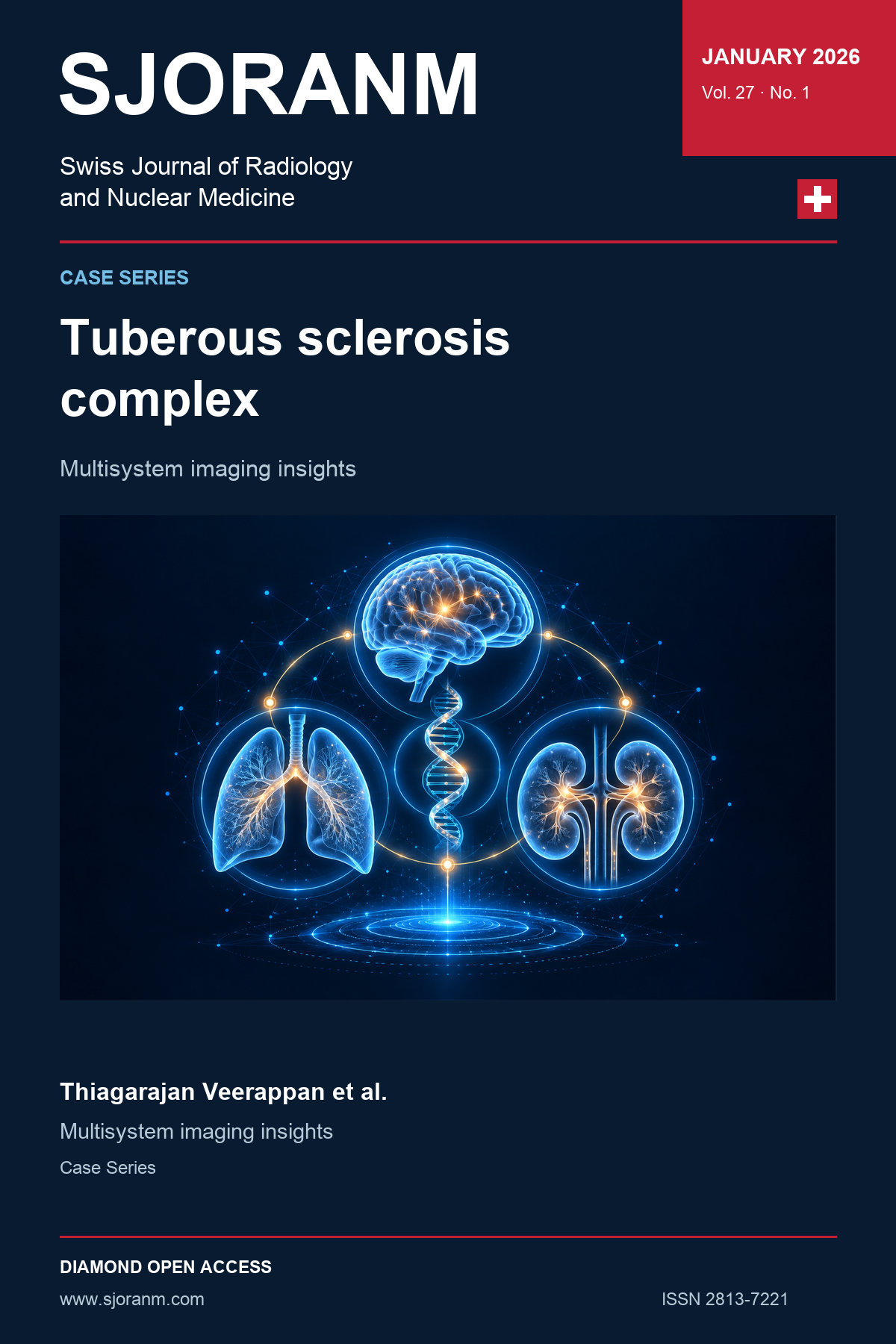
Visual Journey through Tuberous Sclerosis Complex: Multisystem Imaging Insights
DOI:
https://doi.org/10.59667/sjoranm.v27i1.20Keywords:
Tuberous sclerosis complex, Subependymal giant cell astrocytoma (SEGA), Renal angiomyolipoma, Lymphangioleiomyomatosis (LAM), Cardiac rhabdomyoma, Neurocutaneous syndromeAbstract
Tuberous sclerosis complex (TSC) is a rare genetic disorder affecting several systems, characterized by hamartomatous lesions in the brain, kidneys, lungs, skin, and bones. Imaging plays a pivotal role in diagnosis and management. We report a case series of four patients exhibiting diverse clinical manifestations who received multimodality imaging from 2022 to 2024. The imaging findings were aligned with clinical and diagnostic criteria established by the 2012 International TSC Consensus guidelines. The cases had distinctive radiological characteristics of TSC, encompassing subependymal nodules, subependymal giant cell astrocytomas (SEGAs), renal angiomyolipomas, pulmonary lymphangioleiomyomatosis (LAM), cutaneous lesions, and skeletal anomalies. Cross-sectional imaging facilitated precise diagnosis and directed therapies, including embolization, for renal pseudoaneurysms. The series highlights the significance of a thorough imaging strategy in recognizing both typical and incidental characteristics of TSC. Prompt identification enables swift diagnosis, focused treatment, and long term surveillance.
---------------------------------------------------------
Discussion
TSC is an uncommon genetic disorder characterized by diverse manifestations and a tendency for hamartomatous growth in many organs (6).
Depending on the organ of involvement, the patient presents with a wide range of clinical symptoms. Consequently, the 2012 International TSC Consensus Conference established revised diagnostic criteria, differentiating between major and minor features. A definitive diagnosis necessitates the presence of two major features or one major feature in conjunction with two minor features (7). Significantly, most of the major features can be discerned by imaging, underscoring the radiologist's essential and prominent function in the diagnosis process.
Cutaneous lesions frequently act as the initial indicator in the diagnosis of TSC, particularly in paediatric and teenage population. Hypomelanotic macules (90%), face angiofibromas (75%), shagreen patches (30%), and ungual fibromas are established dermatological manifestations (8). In Case 4, the occurrence of many angiofibromas and hypopigmented macules triggered imaging referrals and subsequent verification of systemic involvement. These lesions facilitate diagnosis, enable genetic counseling, and initiate screening for at-risk relatives.
Neurological involvement occurs in more than 90% of patients and represents the earliest clinical manifestation, especially in the form of seizures (9). The classic triad observed on imaging includes cortical tubers, SENs, and SEGA. Cortical tubers and/or subependymal nodules represent the predominant CNS manifestations, exhibiting a prevalence of 95-100% (10). Approximately 40% of cases also exhibit white matter lesions like radial migration lines (RML) (11).
Cortical tubers are hyperintense lesions on T2/FLAIR imaging within the cerebral cortex, which act as epileptogenic foci. SEGAs commonly develop adjacent to the foramen of Monro and can lead to obstructive hydrocephalus (12). In our series, two patients exhibited SEGAs, each exceeding 1 cm in size and displaying avid enhancement, aligning with established diagnostic criteria. SEN typically manifests on the ependymal surface of the lateral ventricles and exhibits a propensity for calcification over time. The possibility of SENs developing into SEGAs, especially in adolescence and early adulthood, highlights the significance of serial CNS imaging.
Renal symptoms are the second most prevalent findings in TSC. Approximately 20% of people with renal AML are identified with TSC, whereas 80% of individuals with TSC present with renal AMLs (13). AMLs are frequently large, bilateral, and multiple in the context of TSC. Cases 1 and 3 revealed substantial bilateral AMLs, accompanied by indications of haemorrhagic consequences and intratumoral aneurysms. AMLs exceeding 4 cm or exhibiting intratumoral aneurysms more than 5 mm are deemed at elevated risk for bleeding and may qualify for embolization or mTOR treatment (14). TSC-associated AML typically manifest at a younger age and exhibit more rapid progression than sporadic variants. Other infrequent renal symptoms encompass bilateral multiple renal cysts, present in approximately 18-53% of cases, and clear cell renal cell carcinoma (RCC), observed in about 2-3% of instances (15).
Pulmonary involvement, predominantly manifesting as lymphangioleiomyomatosis (LAM), is an acknowledged characteristic of TSC, affecting approximately 26 to 39% of women with the condition (16). LAM is distinguished by diffuse, thin-walled cysts shown on high-resolution CT, frequently associated with ground-glass opacities or chylous effusions.
Case 3 has characteristic symptoms of LAM, stressing the necessity for chest imaging in asymptomatic adult female patients with TSC, due to the likelihood for spontaneous pneumothorax. LAM may sometimes manifest sporadically, necessitating additional major features for a conclusive diagnosis of TSC. Additional uncommon thoracic conditions encompass multifocal micronodular pneumocyte hyperplasia (MMPH) and clear cell sugar tumour (CCST) of the lung (13).
The principal cardiac manifestation of TSC is cardiac rhabdomyomas, which are the most often identified lesions in utero or in newborns. It manifests in approximately 70% of children, with the majority regressing during childhood. They are typically asymptomatic but can induce deadly arrhythmias, necessitating resection (17).
Skeletal involvement, although frequently incidental, includes sclerotic bone lesions, especially inside the axial skeleton (18).
Although asymptomatic, their existence, as observed in Cases 2 & 4, reinforces the diagnosis and may function as minor or ancillary criteria when the clinical presentation is ambiguous. Additional abdominal manifestations include hepatic angiomyolipomas, splenic hamartomas, and colorectal polyps in a minor percentage of TSC individuals (18).
The management of TSC is multidisciplinary and increasingly influenced by imaging techniques. The introduction of mTOR inhibitors, such as Everolimus, has transformed the treatment of TSC-associated SEGAs and AMLs (19). Serial imaging is essential for evaluating progression, guiding treatment response, and monitoring complications, thereby requiring precise baseline imaging and subsequent measurements. In summary, imaging serves as cornerstone in the assessment and management of TSC.
Conclusion
This case series emphasizes the diverse radiological manifestations of TSC, high-lighting the necessity of a thorough, cross-sectional imaging strategy—especially in individuals exhibiting apparently isolated symptoms. Prompt recognition of distinctive lesions, such as SEGAs, renal angiomyolipomas, and pulmonary cysts, not only enhances rapid diagnosis but also directs clinical judgements for surgical or medical interventions. Radiologists must be attentive to subtle diagnostic imaging clues, since these may be crucial in identifying a potentially overlooked multisystem disorder.
References
1. Domínguez-Valdez LF, Hernández-Utrera JE, Chávez-Sánchez IN, et al. Late diagnosis of tuberous sclerosis: a case report. Oxf Med Case Reports. 2023;2023(4):omad029. Published 2023 Apr 20. https://doi.org/10.1093/omcr/omad029 DOI: https://doi.org/10.1093/omcr/omad029
2. Dzefi-Tettey K, Edzie EK, Gorleku P, Piersson AD, Cudjoe O. Tuberous Sclerosis: A Case Report and Review of the Literature. Cureus. 2021;13(1):e12481. Published 2021 Jan 4. https://doi.org/10.7759/cureus.12481 DOI: https://doi.org/10.7759/cureus.12481
3. Cao Y, Zhang H, Wang F, Zhu D, Liao M. Case Report Radiological appearance of tuberous sclerosis complex: a case report and review of literature. Int J Clin Exp Med. 2017;10(5):8282-8287. https://e-century.us/files/ijcem/10/5/ijcem0050976.pdf
4. Manoukian SB, Kowal DJ. Comprehensive imaging manifestations of tuberous sclerosis. AJR Am J Roentgenol. 2015;204(5):933-943. https://doi.org/10.2214/AJR.13.12235 DOI: https://doi.org/10.2214/AJR.13.12235
5. Alshoabi SA, Hamid AM, Alhazmi FH, et al. Diagnostic features of tuberous sclerosis complex: case report and literature review. Quant Imaging Med Surg. 2022;12(1):846-861. https://doi.org/10.21037/qims-21-412 DOI: https://doi.org/10.21037/qims-21-412
6. Kharrazi MH, Haghighatkhah HR, Noori M, Taheri MS. Intracranial Manifestations of Tuberous Sclerosis: A Pictorial Essay. Iranian Journal of Radiology. 2008;5(4):221-230. https://brieflands.com/journals/ijradiology/articles/79011.pdf
7. Gupta P, Kukreja R, Mital M, Rathee N. A case series of tuberous sclerosis complex: Clinico-radiological study and review of the literature. West African Journal of Radiology. 2017;24(1):109. https://doi.org/10.4103/1115-3474.198155 DOI: https://doi.org/10.4103/1115-3474.198155
8. Umeoka S, Koyama T, Miki Y, Akai M, Tsutsui K, Togashi K. Pictorial review of tuberous sclerosis in various organs. Radiographics. 2008;28(7):e32. https://doi.org/10.1148/rg.e32 DOI: https://doi.org/10.1148/rg.e32
9. Stein JR, Reidman DA. Imaging Manifestations of a Subependymal Giant Cell Astrocytoma in Tuberous Sclerosis. Case Rep Radiol. 2016;2016:3750450. https://doi.org/10.1155/2016/3750450 DOI: https://doi.org/10.1155/2016/3750450
10. Passeri HR, Reis F, Luciano, Chwal BC, Duarte JÁ. Imaging of central nervous system manifestations of Tuberous Sclerosis: a current pictorial review for an “old” disease. Brazilian Journal of Health Review. 2023;6(2):8127-8144. https://doi.org/10.34119/bjhrv6n2-294 DOI: https://doi.org/10.34119/bjhrv6n2-294
11. Fujii H, Sato N, Kimura Y, et al. MR Imaging Detection of CNS Lesions in Tuberous Sclerosis Complex: The Usefulness of T1WI with Chemical Shift Selective Images. AJNR Am J Neuroradiol. 2022;43(8):1202-1209. https://doi.org/10.3174/ajnr.A7573 DOI: https://doi.org/10.3174/ajnr.A7573
12. Aden M, Fawzi MO, Prosser D, et al. Central nervous system manifestations of tuberous sclerosis complex: A single centre experience in Qatar. Saudi Med J. 2024;45(11):1245-1252. https://doi.org/10.15537/smj.2024.45.11.20240444 DOI: https://doi.org/10.15537/smj.2024.45.11.20240444
13. Radhakrishnan R, Verma S. Clinically relevant imaging in tuberous sclerosis. J Clin Imaging Sci. 2011;1:39. https://doi.org/10.4103/2156-7514.83230 DOI: https://doi.org/10.4103/2156-7514.83230
14. Garg P, Sharma A, Rajani H, Choudhary AR, Meena R. Tuberous sclerosis complex: The critical role of the interventional radiologist in management. SA J Radiol. 2021;25(1):2034. Published 2021 Mar 30. https://doi.org/10.4102/sajr.v25i1.2034 DOI: https://doi.org/10.4102/sajr.v25i1.2034
15. Jawaid B, Qureshi AH, Ahmed N, Yaqoob N. Bilateral renal angiomyolipomas in tuberous sclerosis. African Journal of Urology. 2021;27(1). https://doi.org/10.1186/s12301-021-00161-x DOI: https://doi.org/10.1186/s12301-021-00161-x
16. Ritter DM, Fessler BK, Ebrahimi-Fakhari D, et al. Prevalence of thoracoabdominal imaging findings in tuberous sclerosis complex. Orphanet J Rare Dis. 2022;17(1):124. Published 2022 Mar 15. https://doi.org/10.1186/s13023-022-02277-x DOI: https://doi.org/10.1186/s13023-022-02277-x
17. von Ranke FM, Faria IM, Zanetti G, Hochhegger B, Souza AS Jr, Marchiori E. Imaging of tuberous sclerosis complex: a pictorial review. Radiol Bras. 2017;50(1):48-54. https://doi.org/10.1590/0100-3984.2016.0020 DOI: https://doi.org/10.1590/0100-3984.2016.0020
18. Wang MX, Segaran N, Bhalla S, et al. Tuberous Sclerosis: Current Update. Radiographics. 2021;41(7):1992-2010. https://doi.org/10.1148/rg.2021210103 DOI: https://doi.org/10.1148/rg.2021210103
19. Franz DN, Krueger DA. mTOR inhibitor therapy as a disease modifying therapy for tuberous sclerosis complex. Am J Med Genet C Semin Med Genet. 2018;178(3):365–73. https://doi.org/10.1002/ajmg.c.31655 DOI: https://doi.org/10.1002/ajmg.c.31655
Downloads
Published
Data Availability Statement
Data required for this study may be made available by the author(s) upon reasonable request.
Issue
Section
License
Copyright (c) 2026 Thiagarajan Veerappan, Geetha Ganesan, Kalpana Sivalingam

This work is licensed under a Creative Commons Attribution 4.0 International License.
This license requires that reusers give credit to the creator. It allows reusers to distribute, remix, adapt, and build upon the material in any medium or format, even for commercial purposes.
 LinkedIn ↗
 X ↗
X ↗ VK ↗
VK ↗ Truth Social ↗
 Bluesky ↗
 YouTube ↗