
Copper-beaten Skull Aspect in Children
Is It Always Pathological? - Age-Related Distribution of the Copper-Beaten Skull Appearance on Pediatric Cephalometric Radiographs: A Retrospective Single-Center Study
DOI:
https://doi.org/10.59667/sjoranm.v33i1.14Keywords:
copper-beaten skull, radiograph, Intracranial pressure, neurology, skullAbstract
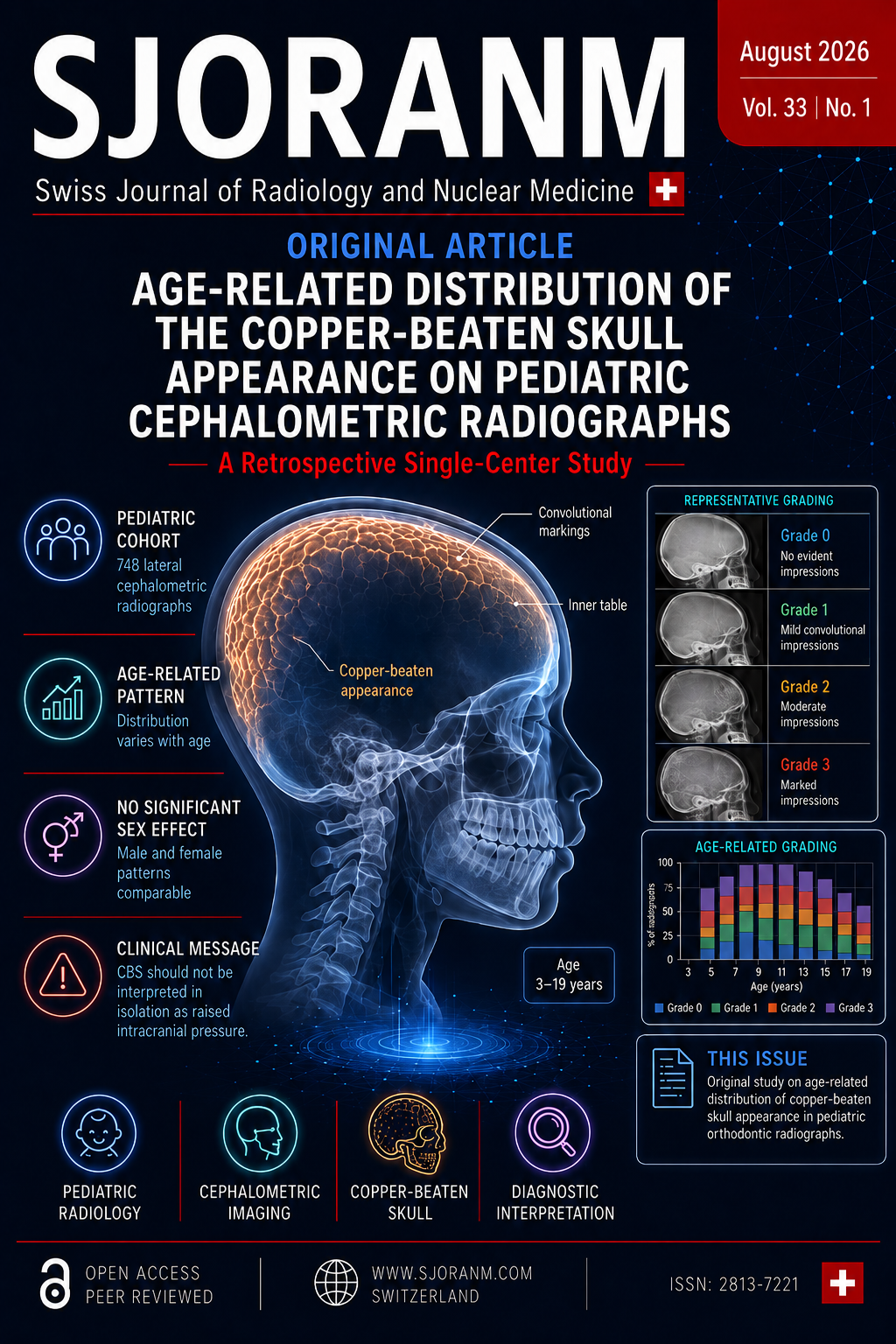
Background: The copper-beaten skull (CBS) appearance on lateral skull radiographs has historically been associated with raised intracranial pressure, but convolutional markings may also occur during normal cranial development. We aimed to characterize the age-related distribution of CBS in a contemporary pediatric orthodontic referral cohort and to compare the observed pattern with classic historical series.
Methods: This single-center retrospective study included 748 lateral skull radiographs from unique patients aged 3–19 years obtained for orthodontic indications between July 2008 and April 2023 (378 female, 370 male). Radiographs were graded 0–3 by two blinded radiologists, with disagreements resolved by consensus. Because the outcome was ordinal and the contingency table contained sparse cells, analyses included a Monte Carlo permutation test, Spearman and Kendall rank correlations, proportional-odds ordinal logistic regression with age, quadratic age, sex, age-by-sex interaction, and sampling period, plus bootstrap and threshold-specific robustness analyses.
Results: Grade distribution was grade 0, n = 55 (7.4%); grade 1, n = 162 (21.7%); grade 2, n = 444 (59.4%); and grade 3, n = 87 (11.6%). Monte Carlo testing confirmed an age–grade association (p = .00055), although rank correlations were weak (Spearman’s ρ = −0.149; Kendall’s τ-b = −0.115; both p < .001). The ordinal model showed a significant nonlinear age effect (linear OR = 0.913, 95% CI 0.858–0.971, p = .004; quadratic OR = 0.977, 95% CI 0.964–0.991, p = .001). Sex, age-by-sex interaction, and sampling period were not significant. Results were directionally similar in the date-restricted principal-period sensitivity cohort (n = 554).
Conclusion: Convolutional skull markings were common in this pediatric orthodontic referral cohort and varied with age but not significantly with sex. A copper-beaten skull appearance should not be interpreted in isolation as evidence of raised intracranial pressure. Because the cohort was selectively supplemented by age and participants were not systematically screened for neurological or craniofacial disease, the observed frequency is not a population prevalence estimate and does not establish physiological normality.
References
1. Sharma R, Priyadarshinni SR, Desai V. Copper Beaten Skull! Can It be a Usual Appearance? International Journal of Clinical Pediatric Dentistry. 2014;7(1): 47. https://doi.org/10.5005/JP-JOURNALS-10005-1233. DOI: https://doi.org/10.5005/jp-journals-10005-1233
2. Ginelliová A, Farkaš D, Iannaccone SF, Vyhnálková V, Vasovčák P. Sudden death associated with syndromic craniosynostosis. Forensic Science, Medicine, and Pathology. 2016;12(4): 506–509. https://doi.org/10.1007/S12024-016-9818-5. DOI: https://doi.org/10.1007/s12024-016-9818-5
3. du Boulay G. The Significance of Digital Impressions in Children’s Skulls. Acta Radiologica. 1956;Original S(1–2): 112–122. https://doi.org/10.1177/028418515604600116. DOI: https://doi.org/10.1177/028418515604600116
4. Macaulay D. Digital Markings in Radiographs of the Skull in Children. https://doi.org/10.1259/0007-1285-24-288-647. 2014;24(288): 647–652. https://doi.org/10.1259/0007-1285-24-288-647. DOI: https://doi.org/10.1259/0007-1285-24-288-647
5. Mahomed N, BCh M, Sewchuran FcrT, BCh Mahomed MZ. The copper-beaten skull. South African Journal of Radiology. 2012;16(1): 25–26. https://doi.org/10.4102/SAJR.V16I1.229. DOI: https://doi.org/10.4102/sajr.v16i1.229
6. Phore S, Panchal R. Beaten silver appearance: Normal or pathognomic in children? International Journal of Oral Health Sciences. 2018;8(1): 51. https://doi.org/10.4103/ijohs.ijohs_28_17. DOI: https://doi.org/10.4103/ijohs.ijohs_28_17
7. Copper Beaten Skull | Pediatric Radiology Reference Article | Pediatric Imaging | @pedsimaging. https://pediatricimaging.org/diseases/copper-beaten-skull/ [Accessed 9th September 2023].
8. Copper beaten skull | Radiology Reference Article | Radiopaedia.org. https://radiopaedia.org/articles/copper-beaten-skull [Accessed 9th September 2023].
9. copper beaten skull | pacs. https://pacs.de/term/copper-beaten-skull [Accessed 9th September 2023].
10. Davidoff L. Convolutional digitations seen in the roentgenograms of immature human skulls. Bull Neurol Inst NY. 1936;5: 61–71.
11. Van Der Meulen J, Van Der Vlugt J, Okkerse J, Hofman B. Early beaten-copper pattern: its long-term effect on intelligence quotients in 95 children with craniosynostosis. Journal of Neurosurgery: Pediatrics. 2008;1(1): 25–30. https://doi.org/10.3171/PED-08/01/025. DOI: https://doi.org/10.3171/PED-08/01/025
Downloads
Published
Data Availability Statement
Data is available upon reasonable request.
Issue
Section
License
Copyright (c) 2026 Thomas Saliba, Alessandro De Leucio, Paolo Simoni, Grammatina Boitsios

This work is licensed under a Creative Commons Attribution 4.0 International License.
This license requires that reusers give credit to the creator. It allows reusers to distribute, remix, adapt, and build upon the material in any medium or format, even for commercial purposes.
 LinkedIn ↗
 X ↗
X ↗ VK ↗
VK ↗ Truth Social ↗
 Bluesky ↗
 YouTube ↗