
The Unusual Pattern of Violation of Weigert Meyer Rule with Ureterocele in an Adult
A Case Report and Literature Review with Review of Associated Embryology
DOI:
https://doi.org/10.59667/sjoranm.v26i1.14Keywords:
CAKUT, Ureterocele, Weigert-Meyer Rule, Stephen's ectopic pathwayAbstract
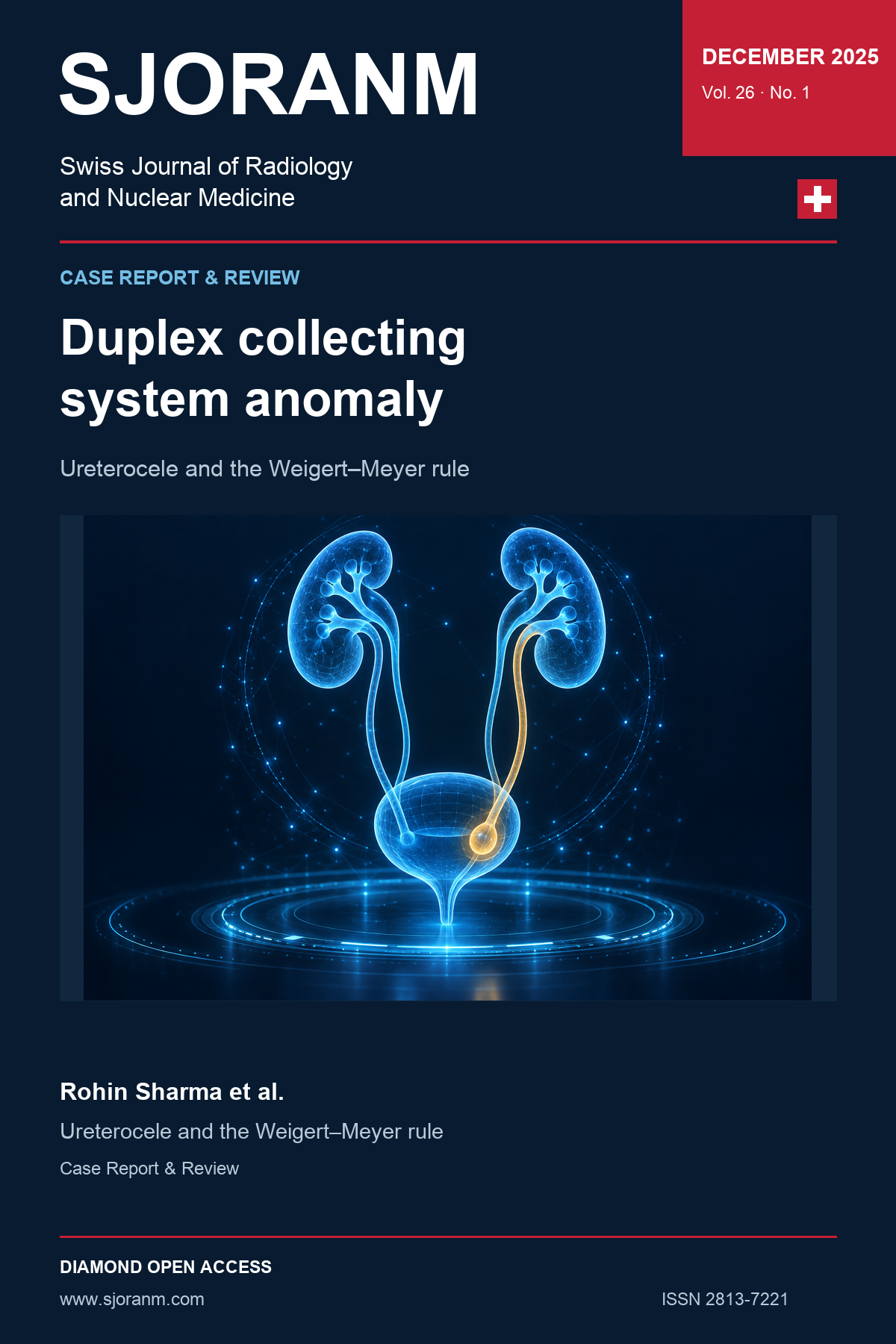
Background: Duplication of renal system is one of the most common congenital anomalies of the urinary tract. The relationship between the drainage of the two moieties into the urinary bladder is described by the Weigert-Meyer rule which states that the moiety opening into the bladder medially and caudally drains the upper pole while the moiety opening laterally and cranially drains the lower pole of the kidney.
Case presentation: We present a case of violation of the Weigert Meyer rule in a 48 year old male who presented primarily in adulthood. On imaging studies, the patient was discovered to have a duplex left renal collecting system with the both moieties draining ectopically into the the bladder and with the lower pole moiety draining caudally and anteriory to the upper pole moiety. We present this case as it describes a rarer variant of a common anomaly as well as for its importance to radiologists and surgeons.
Conclusions: Radiologists and urologists should bear in mind the possibility of these violations when dealing with patients with a duplex system. Furthermore, patients with congenital urinary tract anomalies may present primarily in adulthood and have an uneventful childhood.
----------------------------------------------------------------------
Background
Congenital abnormalities of the kidney and urinary tract (CAKUT) are the most common anomalies detected in neonates, with an incidence of nearly 3 to 6 per 1000 live births (1). Some of the common anomalies include horseshoe kidneys, duplicated systems, ureteropelvic junction obstruction, etc. The genetic basis for most of these anomalies involves the same molecular pathway which plays a key role in the development of the renal system (2). Duplication of the renal system, albeit a relatively rare occurrence, is one of the most common renal anomalies, seen in about 0.2-2% of the population. It is more common in females, and unilateral involvement is more commonly seen than bilateral involvement (1,3). Duplication may be complete or incomplete. In an incomplete duplex system, the draining systems of both the renal poles drain into the bladder through the same ureteral opening while in complete duplex systems the drainage is via separate ureteral openings (1). In a complete duplex system, the relationship between the drainage of the two moieties into the bladder is described by the Weigert-Meyer rule (4,5). Urinary tract anomalies are commonly diagnosed in children who usually present with obstructive symptoms, reflux, or urinary tract infections associated with complications of these anomalies (4-7). In this article we describe the case of an adult patient with an uneventful childhood who presented with an unusual pattern of deviation from the Weigert Meyer rule.
Case presentation
A 48 year old male presented in 2023 with episodic lower abdominal and pelvic pain with burning micturition for 1 year. Physical examination was unremarkable. The patient had no significant prior clinical history or family history. Urine microscopy showed microscopic hematuria. Routine investigations including renal function tests were within the normal limit.
The patient underwent ultrasonography (Figure 1A-C and Figure 2A-C) which revealed focal ectasia of the calyces of the upper pole of left kidney. The right kidney was normal in morphology. Two echogenic structures showing posterior acoustic shadowing were visualised within the lumen of the urinary bladder on either side, suggestive of calculi. The calculus visualized on the left side was surrounded by a thin rim of echogenic soft tissue and showed no displacement on changing the position of the patient. The calculus on the right side showed displacement to the dependent position on change in patient decubitus.
For better assessment and to see the excretory function of the kidneys, further investigation with a CT urography (Figure 3A-F) was performed. The scan and the volume rendered images (Figure 4A-C) derived from it revealed complete duplication of the collecting system of the left kidney with the upper and lower pole moieties showing normal contrast uptake and excretion. The upper pole moiety showed a focal dilation of the intravesical portion, suggestive of ureterocele, with a calculus noted within the same. Few other smaller calculi were also seen in the distal aspect of left upper pole ureter just proximal to the vesicoureteric junction, with resultant upstream hydro-uretero-nephrosis of the entire left upper pole collecting system. The lower pole moiety, which was expected to be orthotopic, drained slightly inferior and anterior to the upper pole moiety, thus deviating from the Weigert-Meyer rule. An intravesical calculus was also visualised. Right kidney was normal in morphology, contrast enhancement and excretion.
Limited sections of T2 weighted coronal MRI (Figure 5A-C) was performed for better anatomical delineation, which revealed a duplicated collecting system on the left with a ureterocele of the left upper pole moiety. Few T2W hypointense filling defects were seen within the ureterocele and the distal aspect of left upper pole ureter with resultant upstream hydro-uretero-nephrosis of the upper pole moiety. However, the lower moiety appeared unremarkable. An unusual finding that was observed was the drainage pattern of upper and lower moieties; the ureters draining both the upper pole moiety and the lower pole moiety had an ectopic drainage into the bladder at a location more inferior to the normally expected vesicoureteric junction. Furthermore, the lower pole moiety drained into the bladder slightly caudal and anterior to the upper pole moiety, thereby violating the Weigert Meyer rule.
The patient was not in favour of undergoing invasive management and was managed conservatively for pain and infection. Unfortunately the patient was lost to follow up following resolution of the infection.
The embryonic development of the urinary tract begins when the nephric duct induces changes in the adjacent mesoderm to sequentially form the pronephros, mesonephros, and ultimately the metanephros. The pronephros is a rudimentary structure and regresses soon after its development. The mesonephros gives rise to the mesonephric duct (Wolffian duct), which forms the bladder and parts of the genital system in males. The metanephros, formed around 5-6 weeks of gestation, is the precursor of renal development. The ureteric bud arises from the mesonephric duct and grows to join with the metanephric mesenchyme. The former gives rise to the collecting system of the kidneys, while the latter forms the renal parenchyma (6).
In an incomplete duplex system, the draining systems of both, the upper and lower renal poles drain into the bladder through the same ureteral opening. It occurs when the ureteric bud arising from the mesonephric duct branches prematurely before reaching the metanephric mesenchyme. The point of branching gives rise to a variety of phenotypic appearances of an incompletely duplicated system, which may range from a bifid pelvis to a bifid ureter. In a complete duplication, the two ureteric moieties course separately and drain into the bladder through separate orifices (6). This occurs when two separate ureteric buds arise from the mesonephric duct and join with the metanephros (1,4,7).
In a complete duplex system, the relationship between the drainage of the two moieties into the bladder is described by the Weigert-Meyer rule, which states, ‘In a complete ureteral duplication, the ureter whose orifice is more medial and caudal reaches the upper moiety and the other ureter whose orifice is more lateral and cephalad reaches the lower renal moiety’. The upper pole moiety which drains into the bladder caudally is said to be ectopic, while the cephalad draining lower pole moiety is considered to be orthotopic (4,5,8).
The basis for this lies in the embryologic development of a duplex system. Embryologically, the lower pole moiety is considered to be akin to the normal ureter of a normal single system kidney, and therefore it drains in its usual orthotopic location. However, the upper pole moiety is said to be similar to an accessory ureter, and follows the pathway of the Wolffian duct to drain into any other mesonephric duct derivative, such as the trigone of the bladder, urethra, genital ducts in males and vagina in females (4).
The complications associated with a duplicated system can be separately categorised into those involving the upper pole moiety (ectopic drainage) and those involving the lower pole moiety (orthotopic drainage) (4,9). The complications associated with the upper pole moiety are more common, and are majorly due to its ectopic insertion. The common upper pole moiety complications include ureterocele, obstruction, and incontinence, while the lower pole is usually afflicted by reflux and its sequelae (4-7).
Duplicated systems, in most cases, show an obstructed upper pole system and a refluxing lower pole collecting system. Furthermore, it presents during the childhood as recurrent urinary tract infections and other related complications while initial presentation in adults is rare (8,11). However, in our case the primary detection of the anomaly occurred in the middle age of the patient. Moreover, although the upper pole moiety did show a ureterocele and an obstructed system, the lower pole moiety did not show any signs of VUR or its sequelae. The patient also did not have any history of recurrent urinary tract infections during childhood.
Majority of the duplicated systems obey the above described Weigert-Meyer rule. However, a handful occurrences of violation of the Weigert Meyer rule have been reported in literature, with most of these deviations being reported in children (10-17). The data regarding prevalence of violation of the stated rule is lacking.
One of the first violations of the rule was reported by Weigert himself in 1878, in which an upper pole moiety was seen draining into the bladder cranially to the lower pole ureter (12).
Stephens in 1958 mentioned 7 cases of violation of the Weigert-Meyer rule wherein the lower pole moiety was seen draining caudally to the upper pole moiety. He also postulated that the ectopic opening were found along a specific pathway and named it the ‘ectopic pathway’ (13).
Ahmed in 1981 reported a case of violation of the stated rule in which the lower pole moiety was seen draining caudally and was associated with a ureterocele, while the upper pole moiety appeared to be attached to a non-functioning ectopic kidney (14).
Brown et al reported a case in 1988 where the lower pole moiety was seen ectopically draining into the ipsilateral epididymis and presenting as epididymitis on the background of a urinary tract infection (12). Slaughehoupt et al reported a similar case in 1997 wherein the ectopic ureter arose from the lower pole of the kidney and was seen draining into the ipsilateral vas deferens (15).
A case of ectopic lower pole ureter with associated cystic dysplasia was reported by Jain et al in 2008 (16).
As depicted in the cases reported by Brown et al and Slaughenhoupt et al where the drainage of the ectopic ureter was noted into a Wolfian duct structure, Mishra et al reported another similar case in 2017 wherein an ectopic ureter arising from the lower pole of the left kidney was seen to drain into the scrotum (10). They were the first to depict the violation of Weigert Meyer rule via a CT reconstruction.
A case of ectopically draining lower pole ureter with associated megaureter, similar to that of Jain et al, was reported by Darr et al in 2020 (11).
Stormont et al reported a peculiar violation of Weigert-Meyer rule in which there was involution of the lower pole moiety (17). Rathbun et al (2020) reported a case of uncrossed ureteral duplication in an infant. with an adynamic obstruction of the lower pole segment, presenting with hydronephrosis in utero (18). Another case of ectopically draining lower pole moiety with stenosis of its vesicular opening and associated megaureter was reported by Kagantsov et al (2022) in a 5 month old infant (19).
In our case, there was a clear diversion from the Weigert Meyer rule, with both the moieties draining into the bladder ectopically; inferior and medial to the expected site of opening. Further, the lower pole moiety was seen draining slightly anteroinferiorly and lateral to the upper pole moiety,
Although many theories have been postulated explaining the mechanism behind the violation of Weiger-Meyer rule, the embryological and molecular basis of these violations still remains unclear.
Conclusion
Thus, while most cases of renal duplication follow the Weigert Meyer rule, this rule is not an absolute law and various phenotypic violations and deviations have been documented. Radiologists and treating urologists should bear in mind the possibility of a violation while dealing with cases of duplicated renal collecting systems. Further, it is possible for patients with duplicated systems to present primarily during adulthood while having an uneventful childhood.
Department of Radiodiagnosis, Maulana Azad Medical College, Bahadur Shah Zafar Marg, Delhi, India
References
1. Kozlov V, Schedl A. Duplex kidney formation: developmental mechanisms and genetic predisposition. F1000Research. 2020;9:2. https://doi.org/10.12688/f1000research.19826.1
2. Toka HR, Toka O, Hariri A, Nguyen HT. Congenital anomalies of kidney and urinary tract. Semin Nephrol. 2010;30(4):374–86. http://dx.doi.org/10.1016/j.semnephrol.2010.06.004
3. Vargau M, Ilieusu D, Dina C, Ionescu C, Bordei P. Morphological characteristics of the double ureter from its origin up to the end. ARS Medica Tomitana. 2014;20(1): 1-5. https://doi.org/10.2478/arsm-2014-0001
4. Chow J. Understanding Duplication Anomalies of the Kidney. In: Diseases of the abdomen and pelvis 2010-2013: Diagnostic Imaging and Interventional Techniques 42nd International Diagnostic Course in Davos (IDKD) Davos, March 21-26, 2010. Scholars Portal; p. 243–6. https://doi.org/10.1007/978-88-470-1637-8
5. Sudhamani S S, Kumar S, Bhalekar S, Roplekar P. The The Weigert – Meyer Law of Ureteral Duplication. Annals of Pathology and Laboratory Medicine. 2019;6(7):C80-2. https://pacificejournals.com/journal/index.php/apalm/article/view/2530
6. dos Santos Junior A, de Miranda D, Simões e Silva A. Congenital anomalies of the kidney and urinary tract: An embryogenetic review. Birth Defects Res C Embryo Today. 2014;102(4):374-81. https://doi.org/10.1002/bdrc.21084
7. Rodriguez M. Congenital Anomalies of the Kidney and the Urinary Tract (CAKUT). Fetal Pediatr Pathol. 2014;33(5-6):293-320. https://doi.org/10.3109/15513815.2014.959678
8. Gómez SF. Unexpected hydronephrosis following the Weigert-Meyer law [Internet]. Eurorad - Brought to you by the ESR. https://www.eurorad.org/case/16030
9. Pan Y, Chen G, Chen H. The left ureterocele and stone of calyceal diverticulum in the patient with bilateral incomplete duplex kidneys managed by flexible ureteroscopy: a case report and literature review. BMC Urol 20, 35 (2020). https://doi.org/10.1186/s12894-020-00604-7
10. Mishra K, Elliott CS. A violation of the Weigert-Meyer law – an ectopic ureter arising from the lower renal pole. J Clin Urol. 2017;10(3):202-4. https://doi.org/10.1177/2051415815570651
11. Darr C, Krafft U, Panic A, Tschirdewahn S, Hadaschik B, Rehme C. Renal duplication with ureter duplex not following Meyer-Weigert-Rule with development of a megaureter of the lower ureteral segment due to distal stenosis – A case report. Urol Case Rep. 2020;28:101038. https://doi.org/10.1016/j.eucr.2019.101038
12. Brown DM, Peterson NR, Schultz RE. Ureteral duplication with lower pole ectopia to the epididymis. J Urol. 1988 Jul;140(1):139-42. https://doi.org/10.1016/s0022-5347(17)41509-6
13. Stephens FD. Anatomical vagaries of double ureters. Australian and New Zealand Journal of Surgery. 1958 Aug;28(1):27–33. https://doi.org/10.1111/j.1445-2197.1958.tb03793
14. Ahmed S. Uncrossed complete ureteral duplication with caudal orthotopic orifice and ureterocele. J Urol. 1981 Jun;125(6):875-7. https://doi.org/10.1016/S0022-5347(17)55239-8
15. Slaughenhoupt B, David Mitcheson H, Lee D. Ureteral duplication with lower pole ectopia to the vas: A case report of an exception to the weigert-meyer law. Urology. 1997;49(2):269-71. https://doi.org/10.1016/S0090-4295(96)00431-1
16. Jain P, Parelkar S, Shah H, Sanghavi B, Mishra P. Uncrossed complete ureteral duplication with dysplastic lower moiety: A violation of the Weigert–Meyer law. J Pediatr Urol. 2008;4(5):404-6. https://doi.org/10.1016/j.jpurol.2008.01.210
17. Stormont G, Makari J, Beavers A, Berrondo C. Massively Dilated Lower Pole Ectopic Megaureter with Involuted Lower Pole Renal Moiety and Collecting System: An Exception to the Meyer-Weigert Rule. Cureus. 2020 Apr 7;12(4):e7577. https://doi.org/10.7759/cureus.7577
18. Rathbun JA, Buatsi EM. Weigert-Meyer law violation with lower pole obstruction and ectopia. Surgical Case Reports. 2020 Feb 28;1–4. https://doi.org/10.31487/j.scr.2020.02.06
19. Kagantsov IM, Kondrateva EA, Karavaeva SA, et al. Lower pole obstructive megaureter of duplex kidney: an exception to the Weigert-Meyer rule. Urology Herald. 2022;10(3):138-144. https://doi.org/10.21886/2308-6424-2022-10-3-138-144
Downloads
Published
Data Availability Statement
Not Applicable
Issue
Section
License
Copyright (c) 2025 Rohin Sharma, Radhika Batra, Gaurav S. Pradhan, Ebinesh Arulnathan

This work is licensed under a Creative Commons Attribution 4.0 International License.
This license requires that reusers give credit to the creator. It allows reusers to distribute, remix, adapt, and build upon the material in any medium or format, even for commercial purposes.