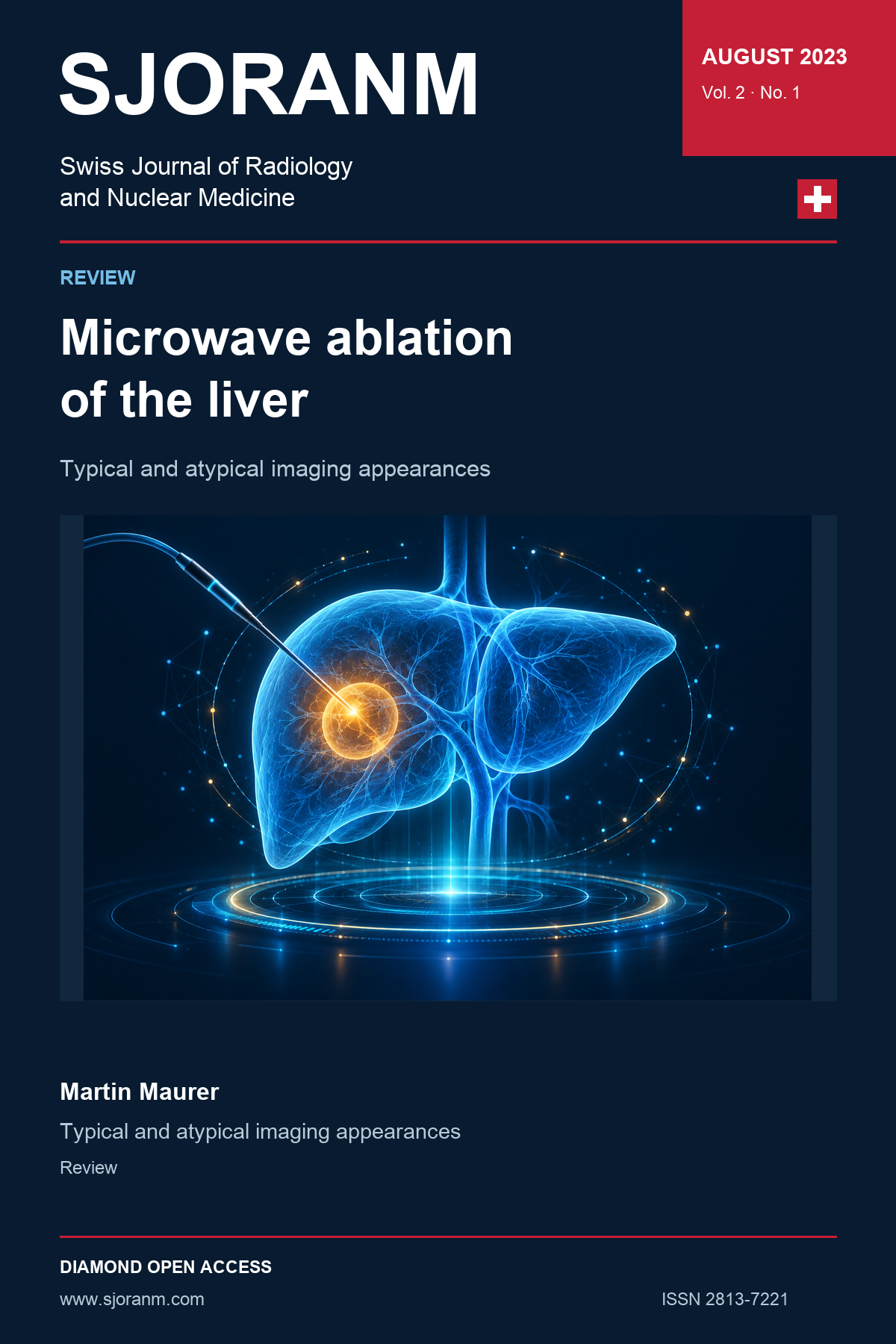
Typical and atypical appearance of microwave ablation zones in the liver
DOI:
https://doi.org/10.59667/sjoranm.v2i1.12Keywords:
microwave ablation, post-ablation imaging, hepatocellular carcinoma, oligometastasesAbstract
Image-guided local ablation is used to treat selected primary and metastatic liver tumors. Contrast-enhanced CT or MRI is essential for assessing technical success, detecting residual or recurrent tumor, and identifying complications. This pictorial review summarizes typical early and follow-up appearances after thermal ablation and highlights findings that may mimic viable tumor. Accurate interpretation requires attention to enhancement rather than attenuation or signal intensity alone, the expected evolution of the ablation zone, and the distribution of peripheral enhancement.
References
1. Gao J, Wang SH, Ding XM, et al. Radiofrequency ablation for single hepatocellular carcinoma 3 cm or less as first-line treatment. World J Gastroenterol. 2015;21(17):5287-5294. https://doi.org/10.3748/wjg.v21.i17.5287 DOI: https://doi.org/10.3748/wjg.v21.i17.5287
2. Vogl TJ, Nour-Eldin NA, Hammerstingl RM, et al. Microwave Ablation (MWA): Basics, Technique and Results in Primary and Metastatic Liver Neoplasms - Review Article. Rofo. 2017;189(11):1055-1066. https://doi.org/10.1055/s-0043-117410 DOI: https://doi.org/10.1055/s-0043-117410
3. Vogl TJ, Muller PK, Hammerstingl R, et al. Malignant liver tumors treated with MR imaging-guided laser-induced thermotherapy: technique and prospective results. Radiology. 1995;196(1):257-265. https://doi.org/10.1148/radiology.196.1.7540310 DOI: https://doi.org/10.1148/radiology.196.1.7540310
4. Brace CL. Microwave ablation technology: what every user should know. Curr Probl Diagn Radiol. 2009;38(2):61-67. https://doi.org/10.1067/j.cpradiol.2007.08.011 DOI: https://doi.org/10.1067/j.cpradiol.2007.08.011
5. Simon CJ, Dupuy DE, Mayo-Smith WW. Microwave ablation: principles and applications. Radiographics. 2005;25 Suppl 1:S69-S83. https://doi.org/10.1148/rg.25si055501 DOI: https://doi.org/10.1148/rg.25si055501
6. Wu H, Exner AA, Krupka TM, et al. Radiofrequency ablation: post-ablation assessment using CT perfusion with pharmacological modulation in a rat subcutaneous tumor model. Acad Radiol. 2009;16(3):321-331. https://doi.org/10.1016/j.acra.2008.09.008 DOI: https://doi.org/10.1016/j.acra.2008.09.008
7. Patel N, King AJ, Breen DJ. Imaging appearances at follow-up after image-guided solid-organ abdominal tumour ablation. Clin Radiol. 2017;72(8):680-690. https://doi.org/10.1016/j.crad.2017.01.014 DOI: https://doi.org/10.1016/j.crad.2017.01.014
8. Lencioni R, Cioni D, Bartolozzi C. Percutaneous radiofrequency thermal ablation of liver malignancies: techniques, indications, imaging findings, and clinical results. Abdom Imaging. 2001;26(4):345-360. https://doi.org/10.1007/s002610000194 DOI: https://doi.org/10.1007/s002610000194
Downloads
Published
Issue
Section
License
Copyright (c) 2023 Martin Maurer

This work is licensed under a Creative Commons Attribution 4.0 International License.
This license requires that reusers give credit to the creator. It allows reusers to distribute, remix, adapt, and build upon the material in any medium or format, even for commercial purposes.
 LinkedIn ↗
 X ↗
 VK ↗
 Truth Social ↗
 Bluesky ↗
 YouTube ↗