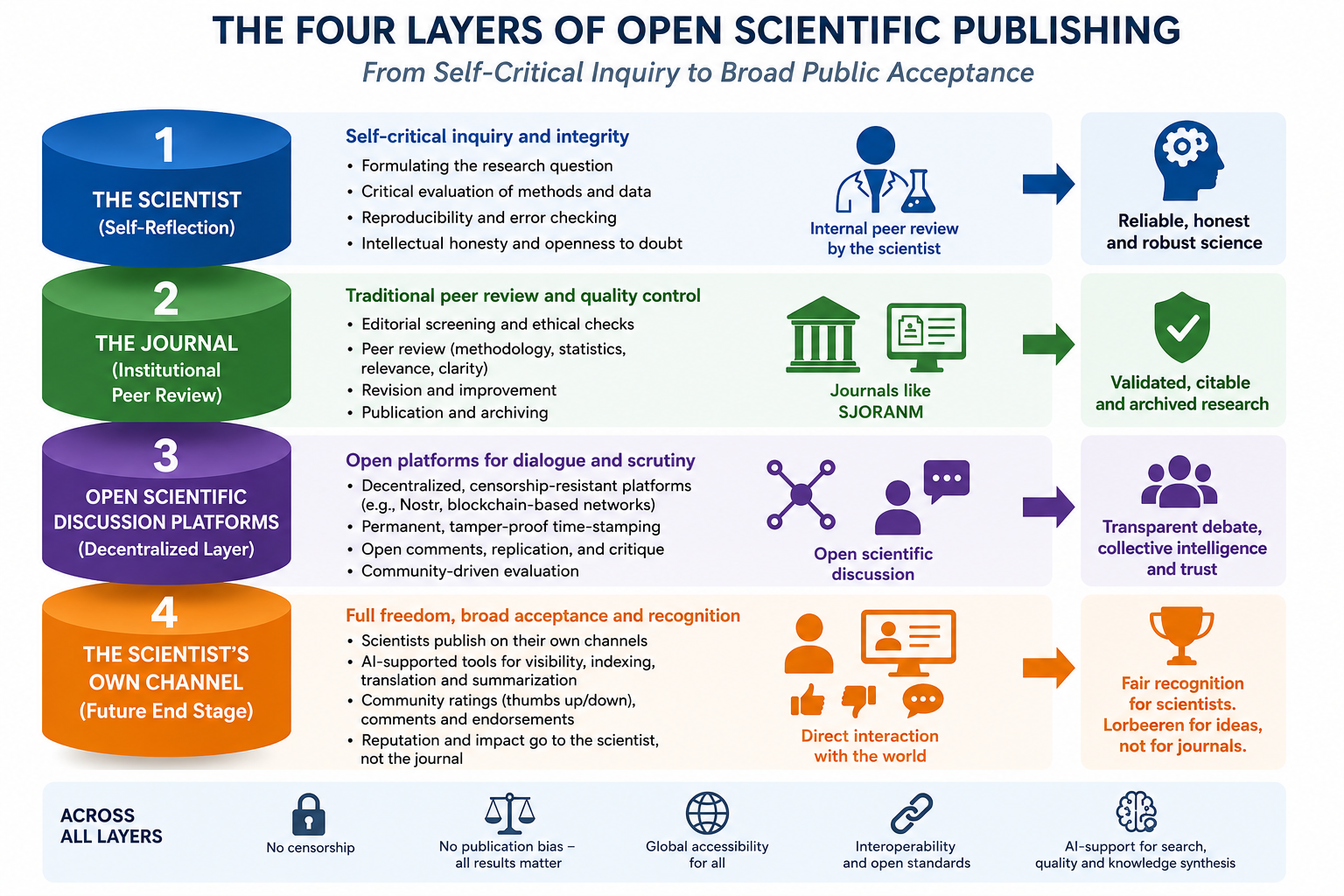
Four-Layer Model of Open Scientific Communication
DOI:
https://doi.org/10.59667/sjoranm.v31i2.14Keywords:
Open Science, Scientific Publishing, Peer Review, Artificial Intelligence, Blockchain, Open Access, Altmetrics, FAIR Principles, Decentralized Science, Future of Scientific CommunicationAbstract
Scientific publishing is being reshaped by digital communication, Open Science, artificial intelligence and decentralized technologies. This editorial proposes a conceptual Four-Layer Model of Open Scientific Communication: (1) the scientist and intellectual honesty; (2) journals and the scientific community; (3) open scientific communication networks; and (4) the scientist within a possible future AI-supported ecosystem. These are complementary, overlapping functions rather than an empirically established sequence of historical stages. The model connects self-criticism and reproducibility with independent editorial evaluation, ongoing post-publication dialogue and recognition based on the quality and long-term influence of individual contributions. Journals remain important for peer review, ethical oversight, curation and preservation. FAIR principles can support reuse without requiring unrestricted access to sensitive data. Blockchain and timestamps may support provenance but do not establish scientific truth, authorship or permanent availability by themselves. AI may assist communication and analysis, while scientific judgment and accountability remain with people. Transparent governance, access controls, correction mechanisms and preservation are necessary. The model offers a framework for discussion about the future of scientific communication in medicine; its benefits and proposed convergence require evaluation.
References
1. Tennant JP, Waldner F, Jacques DC, Masuzzo P, Collister LB, Hartgerink CHJ. The academic, economic and societal impacts of Open Access: an evidence-based review. F1000Research 2016;5:632. DOI: https://doi.org/10.12688/f1000research.8460.3 DOI: https://doi.org/10.12688/f1000research.8460.2
2. Bornmann L, Daniel HD. What do citation counts measure? A review of studies on citing behavior. J Doc 2008;64(1):45-80. DOI: https://doi.org/10.1108/00220410810844150 DOI: https://doi.org/10.1108/00220410810844150
3. Nosek BA, Alter G, Banks GC, Borsboom D, Bowman SD, Breckler SJ, Buck S, Chambers CD, Chin G, Christensen G, et al. Promoting an open research culture. Science 2015;348(6242):1422-1425. DOI: https://doi.org/10.1126/science.aab2374 DOI: https://doi.org/10.1126/science.aab2374
4. Ross-Hellauer T. What is open peer review? A systematic review. F1000Research 2017;6:588. DOI: https://doi.org/10.12688/f1000research.11369.2 DOI: https://doi.org/10.12688/f1000research.11369.1
5. Heise C, Pearce JM. From Open Access to Open Science: The Path From Scientific Reality to Open Scientific Communication. SAGE Open. 2020;10(2). DOI: https://doi.org/10.1177/2158244020915900 DOI: https://doi.org/10.1177/2158244020915900
6. Priem J, Piwowar HA, Hemminger BM. Altmetrics in the wild: Using social media to explore scholarly impact. arXiv 2012. DOI: https://doi.org/10.48550/arXiv.1203.4745
7. Niya SR, Pelloni L, Wullschleger S, Schaufelbühl A, Bocek T, Rajendran L, Stiller B. A blockchain-based scientific publishing platform. In: ICBC 2019 - IEEE International Conference on Blockchain and Cryptocurrency. IEEE; 2019. p. 329-336. DOI: https://doi.org/10.1109/BLOC.2019.8751379 DOI: https://doi.org/10.1109/BLOC.2019.8751379
8. Ioannidis JPA. Why most published research findings are false. PLoS Med 2005;2(8):e124. DOI: https://doi.org/10.1371/journal.pmed.0020124 DOI: https://doi.org/10.1371/journal.pmed.0020124
9. Wilkinson MD, Dumontier M, Aalbersberg IJ, Appleton G, Axton M, Baak A, et al. The FAIR Guiding Principles for scientific data management and stewardship. Sci Data 2016;3:160018. DOI: https://doi.org/10.1038/sdata.2016.18 DOI: https://doi.org/10.1038/sdata.2016.18
10. Nielsen MA. Reinventing Discovery: The New Era of Networked Science. Princeton (NJ): Princeton University Press; 2011. DOI: https://doi.org/10.1515/9781400839452 DOI: https://doi.org/10.1515/9781400839452
11. Royal Society. 360 years of Royal Society Publishing. History of the Philosophical Transactions. https://www.royalsociety.org/journals/publishing-activities/publishing350/publishing360/ (accessed 5 October 2026).
Downloads
Published
Data Availability Statement
Not applicable
Issue
Section
License
Copyright (c) 2026 Frank Mosler, Gerd Nöldge, Keivan Daneshvar

This work is licensed under a Creative Commons Attribution 4.0 International License.
This license requires that reusers give credit to the creator. It allows reusers to distribute, remix, adapt, and build upon the material in any medium or format, even for commercial purposes.
 LinkedIn ↗
 X ↗
X ↗ VK ↗
VK ↗ Truth Social ↗
 Bluesky ↗
 YouTube ↗