Four-Layer Model of Open Scientific Communication

Authors

DOI:

https://doi.org/10.59667/sjoranm.v31i2.14

Keywords:

Open Science, Scientific Publishing, Peer Review, Artificial Intelligence, Blockchain, Open Access, Altmetrics, FAIR Principles, Decentralized Science, Future of Scientific Communication

Abstract

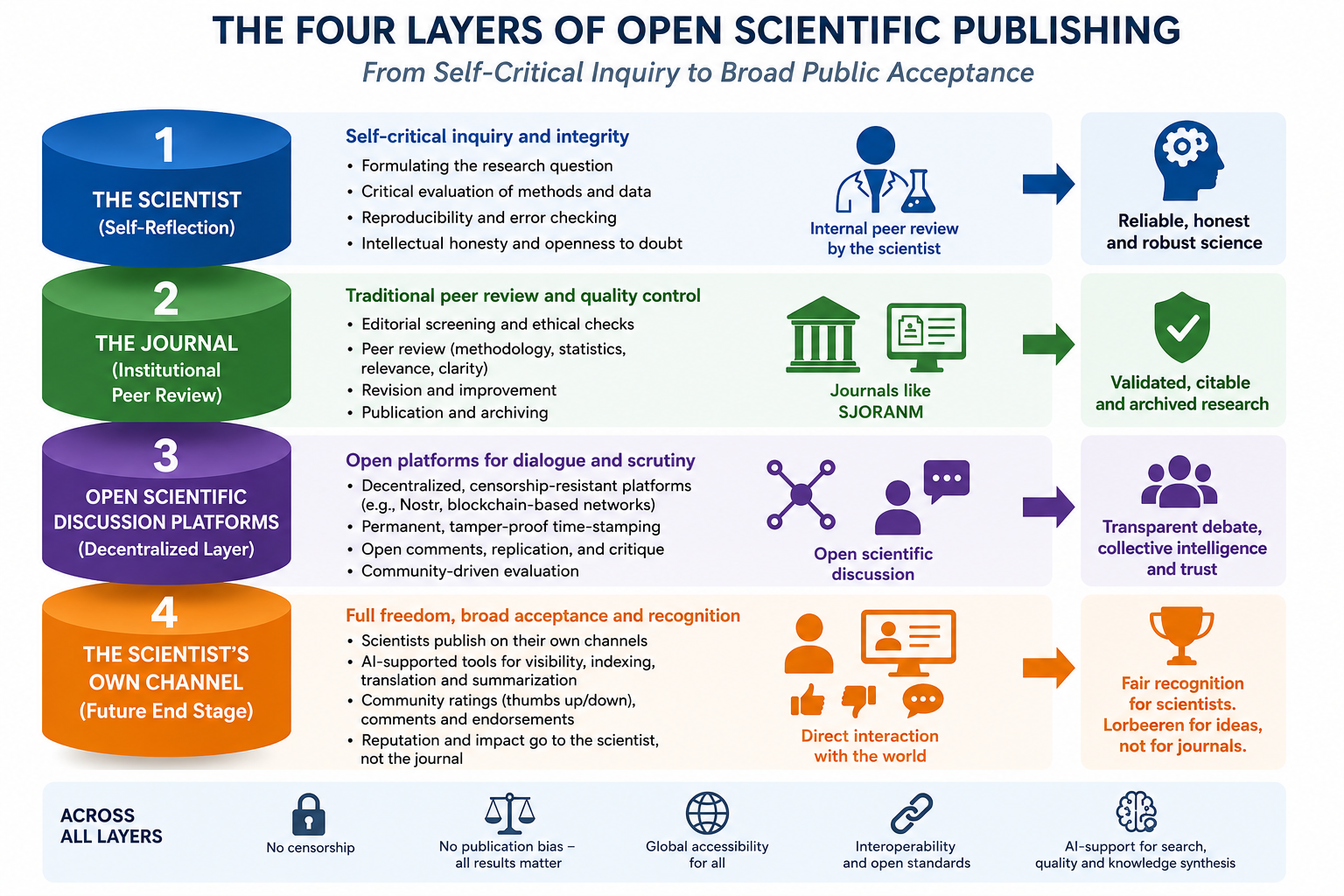
Scientific publishing is being reshaped by digital communication, Open Science, artificial intelligence and decentralized technologies. This editorial proposes a conceptual Four-Layer Model of Open Scientific Communication: (1) the scientist and intellectual honesty; (2) journals and the scientific community; (3) open scientific communication networks; and (4) the scientist within a possible future AI-supported ecosystem. These are complementary, overlapping functions rather than an empirically established sequence of historical stages. The model connects self-criticism and reproducibility with independent editorial evaluation, ongoing post-publication dialogue and recognition based on the quality and long-term influence of individual contributions. Journals remain important for peer review, ethical oversight, curation and preservation. FAIR principles can support reuse without requiring unrestricted access to sensitive data. Blockchain and timestamps may support provenance but do not establish scientific truth, authorship or permanent availability by themselves. AI may assist communication and analysis, while scientific judgment and accountability remain with people. Transparent governance, access controls, correction mechanisms and preservation are necessary. The model offers a framework for discussion about the future of scientific communication in medicine; its benefits and proposed convergence require evaluation.

Author Biographies

  • Frank Mosler, Department of Diagnostic, Interventional and Pediatric Radiology, Inselspital, University Hospital of Bern, University of Bern

    Board-certified Radiologist & Neuroradiologist; Senior Consultant, Inselspital, Bern University Hospital

    Dr. med. Frank Mosler is a board-certified radiologist and neuroradiologist with more than 30 years of clinical and academic experience across major European university centers. He completed his medical education and early specialty training in radiology and neurosurgery at Charité University Hospital in Berlin. He later specialized in interventional neuroradiology at Alfried Krupp Hospital in Essen, where he also held senior leadership responsibilities.

    His professional career has included academic medicine, diagnostic and interventional radiology, neuroradiology, healthcare management, quality assurance, and scientific publishing in Germany and Switzerland. Since 2017, he has been affiliated with the Department of Diagnostic, Interventional and Pediatric Radiology (DIPR) at Inselspital, Bern University Hospital.

    As Editor-in-Chief of the Swiss Journal of Radiology and Nuclear Medicine, Dr. Mosler leads the journal's editorial and scientific strategy and holds overall responsibility for editorial policy, publication standards, scientific integrity, and final editorial decision-making.

    Institutional affiliation: University Institute of Diagnostic, Interventional and Pediatric Radiology, Inselspital
    Location: Bern, Switzerland
    ROR: 01q9sj412

  • Gerd Nöldge, Department of Diagnostic, Interventional and Pediatric Radiology, Inselspital, University Hospital of Bern, University of Bern

    Founding Editor & Honorary Editor
    Switzerland & Germany
    Senior Consultant Radiology, University Hospitals Heidelberg & Bern

    Prof. Dr. med. Gerd Nöldge is a renowned German radiologist and pioneer in interventional radiology. As former Senior Consultant at Heidelberg University Hospital, he made groundbreaking contributions to gastrointestinal artery embolization, for which he received the inaugural Wilhelm Conrad Röntgen Prize in 1985. He played a key role in advancing kyphoplasty techniques for osteoporotic vertebral fractures, providing long-term evidence for the efficacy and stability of calcium phosphate cement in vertebral body augmentation.

    Prof. Nöldge has also significantly contributed to the clinical development and refinement of transjugular intrahepatic portosystemic shunt (TIPS) procedures, improving outcomes in patients with portal hypertension. His dedication to education and international collaboration has fostered enduring partnerships, including medical exchange programs with leading institutions in China.

    As Founding Editor of the Swiss Journal of Radiology and Nuclear Medicine, Prof. Nöldge played a decisive role in the establishment and early development of SJORANM. His appointment as Honorary Editor recognizes his founding contribution, his longstanding scientific commitment, and his lasting importance to the journal. 

    Former institutional affiliation: University Hospital Heidelberg – Diagnostic and Interventional Radiology
    Location: Heidelberg, Germany & Bern, Switzerland
    ROR: 013czdx64

  • Keivan Daneshvar, University of Bern, University Hospital of Bern, Department of Diagnostic, Interventional and Pediatric Radiology, Inselspital, Bern University Hospital, University of Bern, Bern, Switzerland

    Head of the Division of Musculoskeletal Radiology, DIPR, Inselspital, Bern

    PD Dr. med. Keivan Daneshvar is a prominent Swiss radiologist and currently serves as Head of the Division of Musculoskeletal Radiology at the University Institute of Diagnostic, Interventional and Pediatric Radiology (DIPR), Inselspital, Bern University Hospital. He also co-leads the Dynamic Imaging Center at sitem-insel, focusing on advanced dynamic and functional musculoskeletal imaging. His clinical expertise centers on musculoskeletal radiology, including MRI/CT/ultrasound of joints, spine, and soft tissues, with special emphasis on sports injuries, degenerative diseases, oncologic MSK imaging, and dynamic/weight-bearing techniques. Dr. Daneshvar has pioneered innovations in AI-assisted diagnostics (e.g., ChatGPT-4.0 for musculoskeletal mass classification and report generation), deep learning reconstruction of accelerated MRI, and multimodal imaging protocols for conditions like diabetic foot, hidradenitis suppurativa, and rotator cuff pathology. As a member of the Editorial Board of the Swiss Journal of Radiology and Nuclear Medicine, he bridges MSK radiology with interventional, pediatric, and nuclear medicine advancements for multidisciplinary musculoskeletal care.

    Institutional affiliation: University Institute of Diagnostic, Interventional and Pediatric Radiology, Inselspital
    Location: Bern, Switzerland
    ROR: 01q9sj412

References

1. Tennant JP, Waldner F, Jacques DC, Masuzzo P, Collister LB, Hartgerink CHJ. The academic, economic and societal impacts of Open Access: an evidence-based review. F1000Research 2016;5:632. DOI: https://doi.org/10.12688/f1000research.8460.3 DOI: https://doi.org/10.12688/f1000research.8460.2

2. Bornmann L, Daniel HD. What do citation counts measure? A review of studies on citing behavior. J Doc 2008;64(1):45-80. DOI: https://doi.org/10.1108/00220410810844150 DOI: https://doi.org/10.1108/00220410810844150

3. Nosek BA, Alter G, Banks GC, Borsboom D, Bowman SD, Breckler SJ, Buck S, Chambers CD, Chin G, Christensen G, et al. Promoting an open research culture. Science 2015;348(6242):1422-1425. DOI: https://doi.org/10.1126/science.aab2374 DOI: https://doi.org/10.1126/science.aab2374

4. Ross-Hellauer T. What is open peer review? A systematic review. F1000Research 2017;6:588. DOI: https://doi.org/10.12688/f1000research.11369.2 DOI: https://doi.org/10.12688/f1000research.11369.1

5. Heise C, Pearce JM. From Open Access to Open Science: The Path From Scientific Reality to Open Scientific Communication. SAGE Open. 2020;10(2). DOI: https://doi.org/10.1177/2158244020915900 DOI: https://doi.org/10.1177/2158244020915900

6. Priem J, Piwowar HA, Hemminger BM. Altmetrics in the wild: Using social media to explore scholarly impact. arXiv 2012. DOI: https://doi.org/10.48550/arXiv.1203.4745

7. Niya SR, Pelloni L, Wullschleger S, Schaufelbühl A, Bocek T, Rajendran L, Stiller B. A blockchain-based scientific publishing platform. In: ICBC 2019 - IEEE International Conference on Blockchain and Cryptocurrency. IEEE; 2019. p. 329-336. DOI: https://doi.org/10.1109/BLOC.2019.8751379 DOI: https://doi.org/10.1109/BLOC.2019.8751379

8. Ioannidis JPA. Why most published research findings are false. PLoS Med 2005;2(8):e124. DOI: https://doi.org/10.1371/journal.pmed.0020124 DOI: https://doi.org/10.1371/journal.pmed.0020124

9. Wilkinson MD, Dumontier M, Aalbersberg IJ, Appleton G, Axton M, Baak A, et al. The FAIR Guiding Principles for scientific data management and stewardship. Sci Data 2016;3:160018. DOI: https://doi.org/10.1038/sdata.2016.18 DOI: https://doi.org/10.1038/sdata.2016.18

10. Nielsen MA. Reinventing Discovery: The New Era of Networked Science. Princeton (NJ): Princeton University Press; 2011. DOI: https://doi.org/10.1515/9781400839452 DOI: https://doi.org/10.1515/9781400839452

11. Royal Society. 360 years of Royal Society Publishing. History of the Philosophical Transactions. https://www.royalsociety.org/journals/publishing-activities/publishing350/publishing360/ (accessed 5 October 2026).
Published

2026-06-30

Data Availability Statement

Not applicable

Issue

Section

Specials

How to Cite

Mosler, F., Nöldge, G., & Daneshvar, K. (2026). Four-Layer Model of Open Scientific Communication. Swiss Journal of Radiology and Nuclear Medicine, 31(2), 1-17. https://doi.org/10.59667/sjoranm.v31i2.14

Share

Similar Articles

1-10 of 51

You may also start an advanced similarity search for this article.

Most read articles by the same author(s)

<< < 1 2 3 > >>