Navigating Complexity
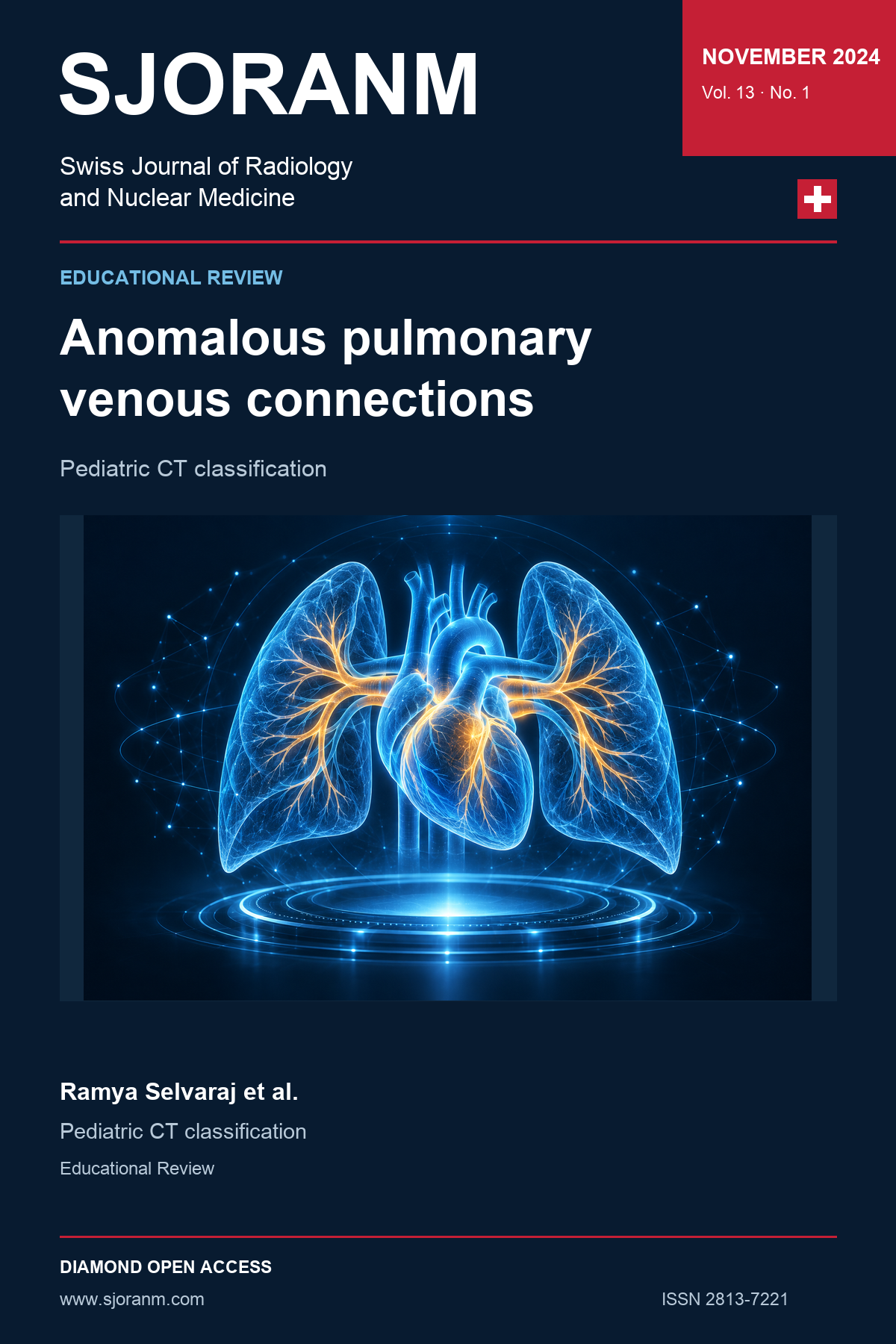
A pictorial representation of anomalous pulmonary venous connection classification in the pediatric population with volume rendering and multiplanar imaging technique
DOI:
https://doi.org/10.59667/sjoranm.v13i1.16Keywords:
TAPVC, volume rendering images, anomalous pulmonary drainage, Scimitar Syndrome, PAPVC, CT angiography, multiplanar reformationAbstract
Anomalous pulmonary venous connections are congenital anomalies in which some or all pulmonary veins connect to the systemic venous circulation or the right atrium rather than the left atrium. Abnormal embryological development may result in partial or total anomalous connections. Multidetector CT angiography, with multiplanar reformations and volume rendering, depicts cardiovascular anatomy and spatial relationships. Partial anomalous connections produce a left-to-right shunt and may cause right heart volume overload and pulmonary hypertension. Total anomalous connections require communication with the left heart and may present with neonatal cyanosis; venous obstruction can cause pulmonary congestion. Accurate anatomical characterization is essential for treatment planning.
References
1. Lyen, S., Wijesuriya, S., Ngan-Soo, E., et al. Anomalous pulmonary venous drainage: a pictorial essay with a CT focus. J Congenit Heart Dis 1, 7 (2017). https://doi.org/10.1186/s40949-017-0008-4 DOI: https://doi.org/10.1186/s40949-017-0008-4
2. Karamlou T, Gurofsky R, Al Sukhni E, et al. Factors associated with mortality and reoperation in 377 children with total anomalous pulmonary venous connection. Circulation 2007; 115:1591–1598 https://doi.org/10.1161/CIRCULATIONAHA.106.635441 DOI: https://doi.org/10.1161/CIRCULATIONAHA.106.635441
3. White CS, Baffa JM, Haney PJ, Pace ME, and Campbell AB. MR imaging of congenital anomalies of the thoracic veins. RadioGraphics 1997; 17:595–608. https://doi.org/10.1148/radiographics.17.3.9153699 DOI: https://doi.org/10.1148/radiographics.17.3.9153699
4. CRAIG JM, DARLING RC, ROTHNEY WB. Total pulmonary venous drainage into the right side of the heart; report of 17 autopsied cases not associated with other major cardiovascular anomalies. Lab Invest. 1957 Jan-Feb;6(1):44-64
5. Seale AN, Uemura H, Webber SA, Partridge J, Roughton M, Ho SY, McCarthy KP, Jones S, Shaughnessy L, Sunnegardh J, Hanseus K, Berggren H, Johansson S, Rigby ML, Keeton BR, and Daubeney PE., British Congenital Cardiac Association. Total anomalous pulmonary venous connection: morphology and outcome from an international population-based study. Circulation. 2010 Dec 21;122(25):2718-26. https://doi.org/10.1161/CIRCULATIONAHA.110.940825 DOI: https://doi.org/10.1161/CIRCULATIONAHA.110.940825
6. Berrocal T, Madrid C, Novo S, Gutiérrez J, Arjonilla A, Gómez-Leo N. Congenital anomalies of the tracheobronchial tree, lung, and mediastinum: embryology, radiology, and pathology. RadioGraphics 2004; 24: e17 https://doi.org/10.1148/rg.e17 DOI: https://doi.org/10.1148/rg.e17
7. Dillman JR, Yarram SG, and Hernandez RJ. Imaging of pulmonary venous developmental anomalies. Am J Roentgenol. 2009;192(5):1272–85. https://doi.org/10.2214/AJR.08.1526 DOI: https://doi.org/10.2214/AJR.08.1526
Downloads
Published
Issue
Section
License
Copyright (c) 2024 Dr. Ramya Selvaraj, Dr. Babu Peter

This work is licensed under a Creative Commons Attribution 4.0 International License.
This license requires that reusers give credit to the creator. It allows reusers to distribute, remix, adapt, and build upon the material in any medium or format, even for commercial purposes.
 LinkedIn ↗
 X ↗
 VK ↗
 Truth Social ↗
 Bluesky ↗
 YouTube ↗