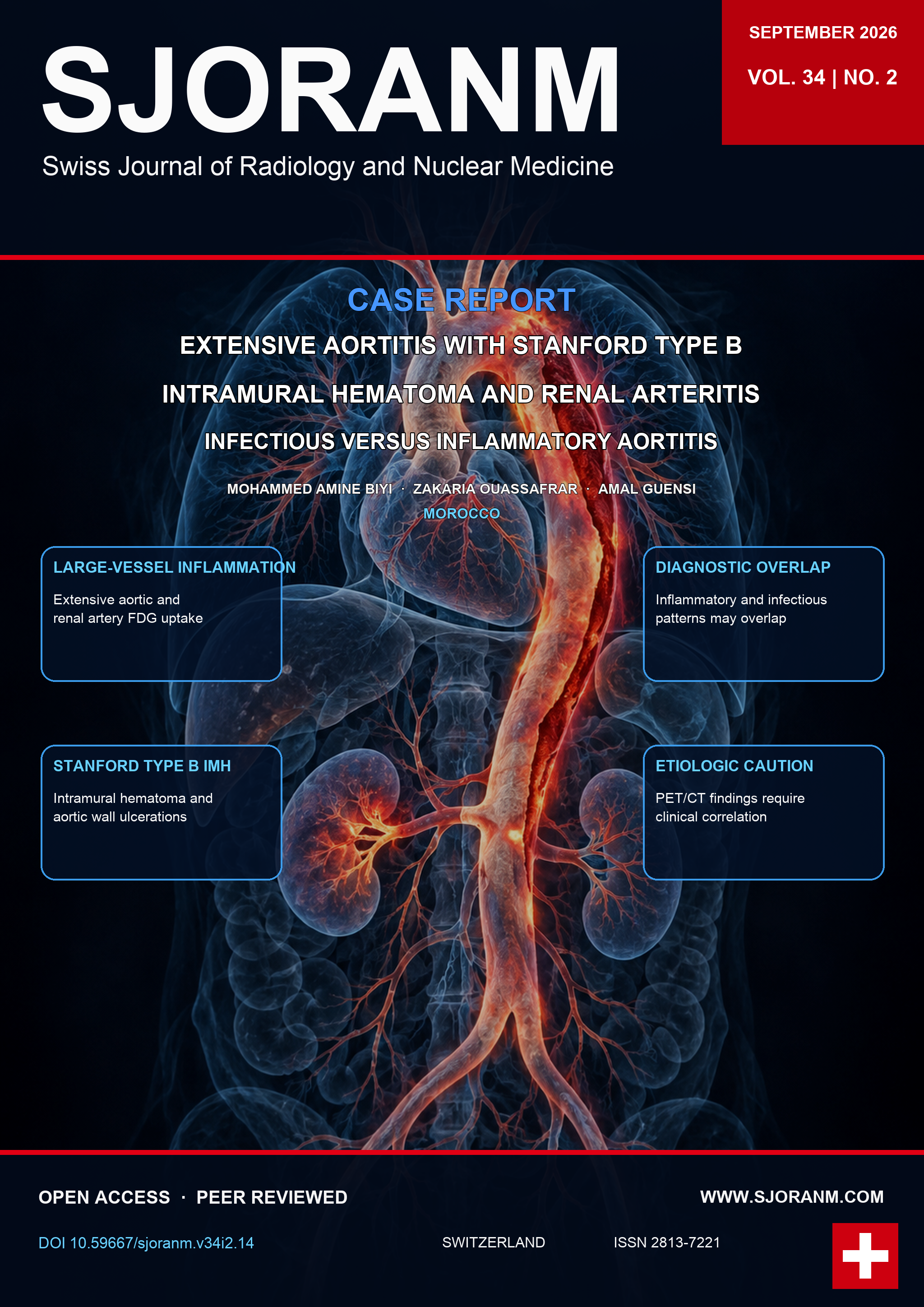
Extensive Aortitis with Stanford Type B Intramural Hematoma and Renal Arteritis: A Nuclear Medicine Perspective on Infectious versus Inflammatory Aortitis
DOI:
https://doi.org/10.59667/sjoranm.v34i2.14Keywords:
18F-FDG PET/CT, aortitis, Stanford type B intramural hematoma, giant cell arteritis, infectious aortitis, syphilisAbstract
Aortitis associated with a Stanford type B intramural hematoma and aortic wall ulcerations requires prompt assessment because both inflammatory and infectious etiologies may produce overlapping imaging findings. We report a 78-year-old woman with poorly controlled hypertension who presented with pulsatile abdominal pain, dyspnea, and vomiting. Marked inflammatory activity was present. 18F-FDG PET/CT demonstrated intense large-vessel uptake, and subsequent CT angiography demonstrated post-isthmic descending aortitis with a Stanford type B intramural hematoma, aortic wall ulcerations, and right renal artery involvement. Treponemal serology was reactive, whereas RPR/VDRL was nonreactive, raising concern for a possible infectious contribution without establishing syphilitic aortitis. The patient subsequently deteriorated, required intensive care, and died shortly thereafter. This case illustrates that inflammatory and infectious aortitis may show overlapping patterns of vascular FDG uptake.
References
1. Seo K, Oiwa H. Syphilitic aortitis incidentally detected by fluorine-18 fluorodeoxyglucose (18F-FDG) PET/CT. Cureus. 2025;17(10):e94353. https://doi.org/10.7759/cureus.94353 DOI: https://doi.org/10.7759/cureus.94353
2. Hellmann DB. Giant cell arteritis, polymyalgia rheumatica, and Takayasu’s arteritis. In: Kelley and Firestein’s Textbook of Rheumatology. 10th ed. Elsevier; 2016:1520–1540. https://doi.org/10.1016/B978-0-323-31696-5.00088-7 DOI: https://doi.org/10.1016/B978-0-323-31696-5.00088-7
3. Ponte C, Grayson PC, Robson JC, et al. 2022 American College of Rheumatology/EULAR classification criteria for giant cell arteritis. Ann Rheum Dis. 2022;81(12):1647–1653. https://doi.org/10.1136/ard-2022-223480 DOI: https://doi.org/10.1002/art.42325
4. Espitia O, et al. Semi-quantitative [18F]FDG-PET/CT ROC-analysis-based cut-offs for aortitis definition in giant cell arteritis. Int J Mol Sci. 2022;23(24):15528. https://doi.org/10.3390/ijms232415528 DOI: https://doi.org/10.3390/ijms232415528
5. Coutinho HMDR, et al. Silent threat: incidental diagnosis and surgical management of a giant syphilitic aortic aneurysm. Case Rep Med. 2025;2025:1281603. https://doi.org/10.1155/carm/1281603 DOI: https://doi.org/10.1155/carm/1281603
6. Maheta D, Agrawal SP, Tated R, et al. Syphilitic cardiac and vascular disease: a comprehensive review. Cardiol Rev. Published online November 3, 2025. https://doi.org/10.1097/CRD.0000000000001115 DOI: https://doi.org/10.1097/CRD.0000000000001115
7. Berhil T, et al. Tertiary syphilis and cardiovascular disease: the united triad: case report. Eur Heart J Case Rep. 2024;8(3):ytae013. https://doi.org/10.1093/ehjcr/ytae013 DOI: https://doi.org/10.1093/ehjcr/ytae013
8. Chaudhary F, et al. Syphilitic aortic aneurysm: a rare entity in the era of antibiotics. Cureus. 2021;13(3):e13647. https://doi.org/10.7759/cureus.13647 DOI: https://doi.org/10.7759/cureus.13647
Downloads
Published
Data Availability Statement
All data relevant to this case report are contained within the article. No separate research dataset was generated.
Issue
Section
License
Copyright (c) 2026 Mohammed Amine Biyi, Zakaria Ouassafrar, Amal Guensi

This work is licensed under a Creative Commons Attribution 4.0 International License.
This license requires that reusers give credit to the creator. It allows reusers to distribute, remix, adapt, and build upon the material in any medium or format, even for commercial purposes.
 LinkedIn ↗
 X ↗
X ↗ VK ↗
VK ↗ Truth Social ↗
 Bluesky ↗
 YouTube ↗