Is Bigger Always Bad ? Evaluating Effect of Sedation on MRI-Based Optic Nerve Sheath Diameter Measurements in Children
DOI:
https://doi.org/10.59667/sjoranm.v27i1.22Keywords:
Intracranial pressure, MRI, Sedation, Optic nerve sheath , ChildrenAbstract
Objectives
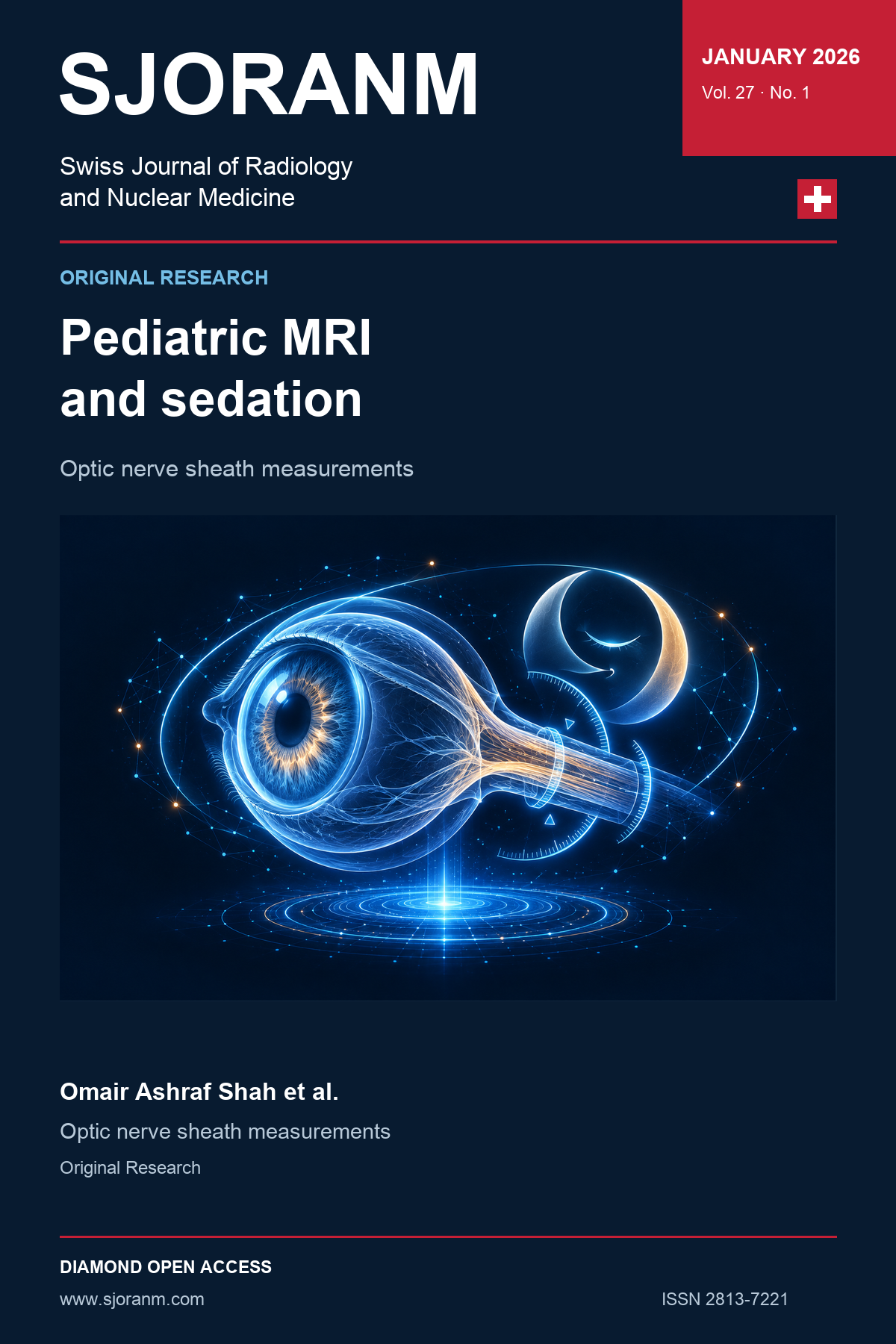
To assess the impact of sedation on optic nerve sheath diameter (ONSD) as measured by MRI in pediatric patients. ONSD is a widely accepted non-invasive marker for estimating raised intracranial pressure (ICP), but potential effects of sedation on its accuracy remain understudied in children.
Materials and Methods
A retrospective observational study was conducted on brain MRI scans from pediatric patients aged 0–18 years. Patients were divided into two groups: those who received sedation and those who underwent MRI without sedation. Bilateral ONSD was measured at a standardized point 3 mm posterior to the globe on axial T2-weighted images. Inter-observer agreement was analyzed, and group comparisons used non-parametric statistical methods.
Results
Out of 78 pediatric patients, 38 received mild sedation and 40 were imaged without sedation. The mean ONSD in the non-sedated group was 4.8 ± 0.3 mm compared to 5.7 ± 0.4 mm in the non-sedated group (p = 0.02). This difference was statistically significant(t(68.5) = -11.2, p < <0.01, Cohen’s d = 2.53). Age-stratified data affirmed a normal increase in ONSD across early childhood with stabilization during adolescence.
Conclusion
Sedation significantly influences ONSD measurements on MRI in pediatric patients. These findings highlight the need for careful consideration of sedation status when using ONSD as a surrogate for ICP. Age-related trends further highlight the importance of using adjusted reference values.
References
1. Rajajee V, Vanaman M, Fletcher JJ, Jacobs TL. Optic nerve ultrasound for the detection of raised intracranial pressure. Neurocrit Care 2011;15(3):506-515. https://doi.org/10.1007/s12028-011-9606-8
2. Koziarz A, Sne N, Kegel F, et al. Bedside optic nerve ultrasonography for diagnosing increased intracranial pressure: A systematic review and meta-analysis. Ann Intern Med 2019;171(12):896-905. https://doi.org/10.7326/M19-0812
3. D’Antona L, Asif H, Craven CL, et al. Brain MRI and ophthalmic biomarkers of intracranial pressure. Neurology 2021;96(22):e2714-e2723. https://doi.org/10.1212/WNL.0000000000012023
4. Sallam A, Abdelaal Ahmed Mahmoud MAA, Kamel MG, et al. The diagnostic accuracy of noninvasive methods to measure the intracranial pressure: A systematic review and meta-analysis. Anesth Analg 2021;132(3):686-695. https://doi.org/10.1213/ANE.0000000000005189
5. Gallagher A, Pike M, Berg S. Beware CSF pressure measured under general anaesthesia. Arch Dis Child 2004;89(7):691. https://doi.org/10.1136/adc.2003.032177
6. Kim Y, Choi S, Kang S, Park B. Propofol affects optic nerve sheath diameter less than Sevoflurane during robotic surgery in the steep Trendelenburg position. Biomed Res Int 2019;2019:5617815. https://doi.org/10.1155/2019/5617815
7. Geeraerts T, Newcombe VF, Coles JP, et al. Use of T2-weighted magnetic resonance imaging of the optic nerve sheath to detect raised intracranial pressure. Crit Care 2008;12(5):R114. https://doi.org/10.1186/cc7006
8. Onder H, Goksungur G, Eliacik S, Ulusoy EK, Arslan G. The significance of ONSD, ONSD/ETD ratio, and other neuroimaging parameters in idiopathic intracranial hypertension. Neurol Res 2021;43(12):1098-1106. https://doi.org/10.1080/01616412.2021.1949688
9. Rajajee V, Vanaman M, Fletcher JJ, Jacobs TL. Optic nerve ultrasound for the detection of raised intracranial pressure. Neurocrit Care 2011;15(3):506-515. https://doi.org/10.1007/s12028-011-9606-8
10. Koziarz A, Sne N, Kegel F, et al. Bedside optic nerve ultrasonography for diagnosing increased intracranial pressure: A systematic review and meta-analysis. Ann Intern Med 2019;171(12):896-905. https://doi.org/10.7326/M19-0812
11. Blaivas M, Theodoro D, Sierzenski PR. Elevated intracranial pressure detected by bedside emergency ultrasonography of the optic nerve sheath. Acad Emerg Med 2003;10(4):376-381. https://onlinelibrary.wiley.com/doi/abs/10.1111/j.1553-2712.2003.tb01352.x
12. Maissan IM, Dirven PJ, Haitsma IK, Hoeks SE, Gommers D, Stolker RJ.Ultrasonographic measured optic nerve sheath diameter as an accurate and quick monitor for changes in intracranial pressure. J Neurosurg 2015;123(3):743-747. https://doi.org/10.3171/2014.10.JNS141197
13. Cardim D, Czosnyka M, Chandrapatham K, Badenes R, Bertuccio A, Noto AD, Donnelly J, Pelosi P, Ball L, Hutchinson PJ, Robba C. Effects of Age and Sex on Optic Nerve Sheath Diameter in Healthy Volunteers and Patients With Traumatic Brain Injury. Front Neurol. 2020 Aug 7;11:764. PMID: 32849220; PMCID: PMC7426488. https://doi.org/10.3389/fneur.2020.00764
Downloads
Published
Data Availability Statement
The data that support the findings of this study are available from the corresponding author upon reasonable request. The data contain potentially identifiable patient information and are therefore not publicaly available in accordance with Institutional review board and data protection regulations.
Issue
Section
License
Copyright (c) 2026 Omair Ashraf Shah, Mudhabir Ashraf, Akib Arfee, Sumaira Maqbool

This work is licensed under a Creative Commons Attribution 4.0 International License.
This license requires that reusers give credit to the creator. It allows reusers to distribute, remix, adapt, and build upon the material in any medium or format, even for commercial purposes.
 LinkedIn ↗
 X ↗
X ↗ VK ↗
VK ↗ Truth Social ↗
 Bluesky ↗
 YouTube ↗