
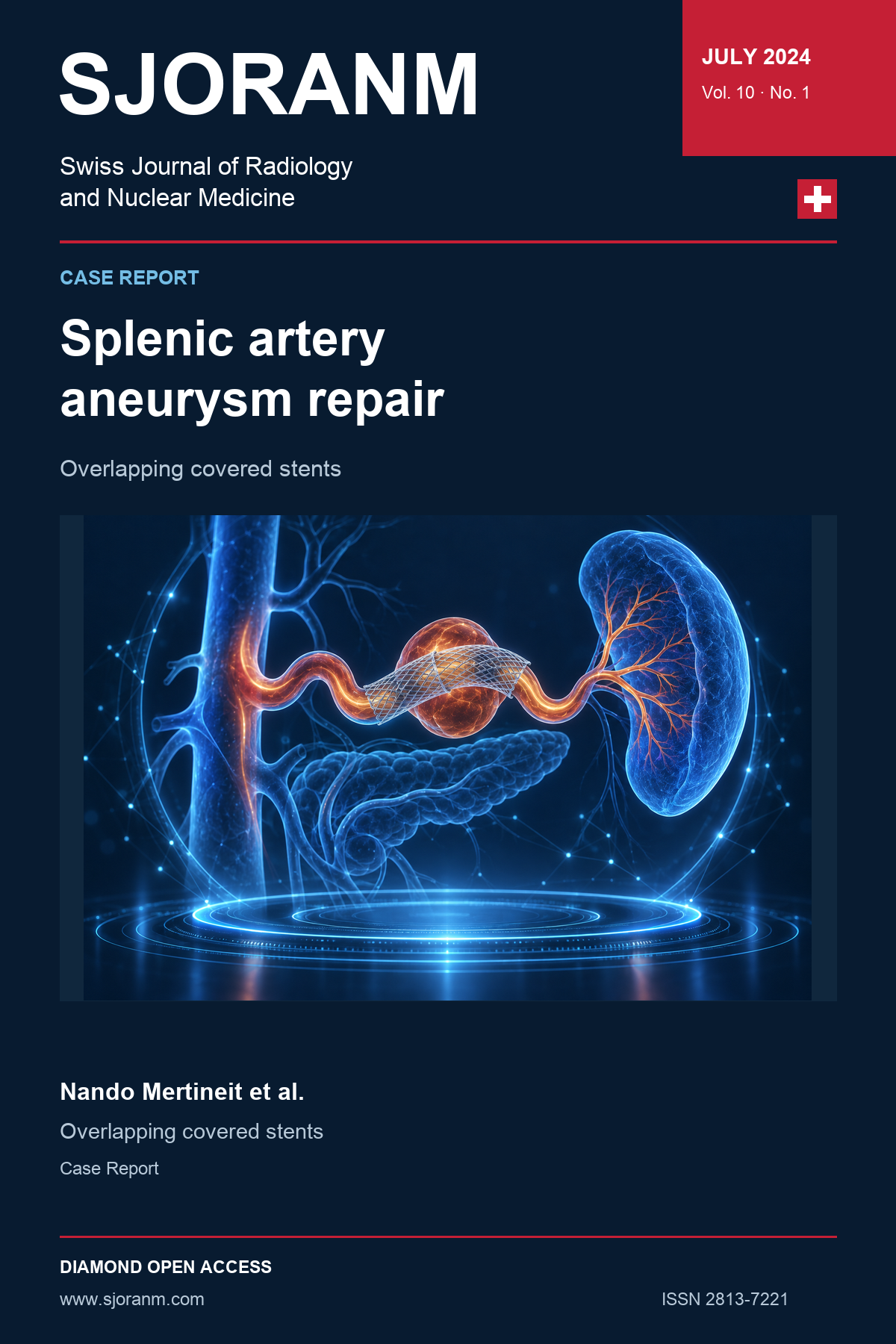
Splenic Artery Aneurysm Occlusion by Overlapping Gore® Viabahn® Endoprosthesis Devices
A Piece of Cake or - Once in a While - a Real Challenge
DOI:
https://doi.org/10.59667/sjoranm.v10i1.12Keywords:
Splenic artery aneurysm, Endovascular treatment, Covered stent, Stent-graft deployment, Gore Viabahn endoprosthesis, Device displacement, Bailout techniqueAbstract
A 63-year-old patient with chronic thoracoabdominal aortic dissection was found to have a 2.2 cm wide-neck splenic artery aneurysm. The interdisciplinary treatment plan required exclusion of the splenic artery aneurysm before fenestrated endovascular aortic repair. During the first intervention, deployment of a Viabahn endoprosthesis was technically difficult. The device kinked and displaced distally, leaving the aneurysm perfused. Because the intervention had already lasted more than 3 hours and required approximately 150 mL of non-ionic contrast medium, the procedure was stopped. The patient was monitored first in the recovery room and then on a regular ward. A longer Viabahn device was ordered and delivered at short notice. Two days later, balloon-assisted realignment of the displaced stent graft and overlapping placement of the second device achieved complete aneurysm exclusion while preserving splenic perfusion. The patient was discharged home the following day. One-year CT angiography confirmed persistent exclusion of the aneurysm and patency of the treated splenic artery. This case illustrates practical bailout techniques for an uncommon but demanding deployment complication.
References
1. Miyazaki M, Udagawa I, Koshikawa H, Ito H, Kaiko S, Suzuki H, Okui K. Transcatheter embolization of splenic artery aneurysm: a case report. Rinsho Hoshasen. 1990;35(5):641-644. https://pubmed.ncbi.nlm.nih.gov/2381111/
2. McDermott VG, Shlansky-Goldberg R, Cope C. Endovascular management of splenic artery aneurysms and pseudoaneurysms. Cardiovasc Intervent Radiol. 1994;17:179-184. https://doi.org/10.1007/BF00571531 DOI: https://doi.org/10.1007/BF00571531
3. Kramann B, et al. Erfahrungen mit der endovaskulären Embolisationstherapie von Aneurysmata der Splanchnikusarterien. RöFo. 1995;163(11). https://doi.org/10.1055/s-2007-1016019 DOI: https://doi.org/10.1055/s-2007-1016019
4. Ruhnke H, Kröncke TJ. Visceral artery aneurysms and pseudoaneurysms: retrospective analysis of interventional endovascular therapy of 43 aneurysms. RöFo. 2017;189(7). https://doi.org/10.1055/s-0043-107239 DOI: https://doi.org/10.1055/s-0043-107239
5. Cappucci M, et al. Endovascular treatment of visceral artery aneurysms and pseudoaneurysms with stent-graft: analysis of immediate and long-term results. Cir Esp Engl Ed. 2017;95(5):283-292. https://www.sciencedirect.com/science/article/abs/pii/S2173507717301047 DOI: https://doi.org/10.1016/j.cireng.2017.04.022
6. Maingard J, et al. Endovascular treatment of wide-necked visceral artery aneurysms using the neurovascular Comaneci neck-bridging device: a technical report. Cardiovasc Intervent Radiol. 2017;40:1784-1791. https://doi.org/10.1007/s00270-017-1733-y DOI: https://doi.org/10.1007/s00270-017-1733-y
7. Ouchi T, et al. Splenic artery aneurysm treated with endovascular stent grafting: a case report and review of literature. Vasc Endovascular Surg. 2018;52(8):663-668. https://doi.org/10.1177/1538574418785252 DOI: https://doi.org/10.1177/1538574418785252
8. Venturini M, et al. Endovascular repair of 40 visceral artery aneurysms and pseudoaneurysms with the Viabahn stent-graft: technical aspects, clinical outcome and mid-term patency. Cardiovasc Intervent Radiol. 2018;41:385-397. https://doi.org/10.1007/s00270-017-1844-5 DOI: https://doi.org/10.1007/s00270-017-1844-5
9. Miyayama S, et al. Stent graft placement for injured visceral artery. Interv Radiol. 2023;8(3):173-183. https://doi.org/10.22575/interventionalradiology.2023-0005 DOI: https://doi.org/10.22575/interventionalradiology.2023-0005
10. Natrella M, Perazzini C, Cristoferi M, Furfaro D, Alessi M, Fanelli G. Neurovascular neck-bridging device in treatment of wide-necked splenic artery aneurysms. Radiol Case Rep. 2021;16(9):2404-2410. https://doi.org/10.1016/j.radcr.2021.05.064 DOI: https://doi.org/10.1016/j.radcr.2021.05.064
11. Lim J, et al. Comaneci device for temporary coiling assistance for treatment of wide-necked aneurysms: initial case series and systematic literature review. World Neurosurg. 2021;149:e85-e91. https://doi.org/10.1016/j.wneu.2021.02.080 DOI: https://doi.org/10.1016/j.wneu.2021.02.080
12. Kim J, Chang C, Jung YJ. Coil embolization results of the ruptured proximal posterior inferior cerebellar artery aneurysm: a single-center 10 years experience. World Neurosurg. 2018;117:e645-e652. https://doi.org/10.1016/j.wneu.2018.06.105 DOI: https://doi.org/10.1016/j.wneu.2018.06.105
13. Ross IB, Dhillon GS. Balloon assistance as a routine adjunct to the endovascular treatment of cerebral aneurysms. Surg Neurol. 2006;66(6):593-601. https://doi.org/10.1016/j.surneu.2006.03.050 DOI: https://doi.org/10.1016/j.surneu.2006.03.050
14. Cao Y, et al. Single-center experience with endovascular treatment for splenic artery aneurysms in long-term follow-up: a retrospective study. Front Cardiovasc Med. 2022;8:793053. https://doi.org/10.3389/fcvm.2021.793053 DOI: https://doi.org/10.3389/fcvm.2021.793053
15. Rabuffi P, et al. Treatment of visceral artery aneurysms and pseudoaneurysms with the use of cerebral flow diverting stents: initial experience. CVIR Endovasc. 2020;3:1-8. https://doi.org/10.1186/s42155-020-00137-y DOI: https://doi.org/10.1186/s42155-020-00137-y
16. Panagrosso M, et al. Double-microcatheter technique through tortuous anatomy for coil embolization of a saccular splenic aneurysm: a technical report. Transl Med UniSa. 2020;21:31. https://pmc.ncbi.nlm.nih.gov/articles/PMC7039270/
17. Lee BC, et al. Endovascular treatment of wide-necked aneurysms of the visceral and renal arteries using the double microcatheter technique via a single access route. Diagn Interv Radiol. 2020;26(5):476. https://doi.org/10.5152/dir.2020.19361 DOI: https://doi.org/10.5152/dir.2020.19361
18. Zhou W, et al. Successful treatment of aberrant splenic artery aneurysm with a combination of coil embolization and covered stents. BMC Surg. 2014;14:62. https://doi.org/10.1186/1471-2482-14-62 DOI: https://doi.org/10.1186/1471-2482-14-62
19. Kuwada N, et al. Endovascular stent graft placement and coil embolization for splenic artery aneurysm with an anatomical variant. Int J Angiol. 2023;32(4):273-276. https://doi.org/10.1055/s-0042-1742588 DOI: https://doi.org/10.1055/s-0042-1742588
20. Pfabe FP. Das Milzarterienaneurysma: Klinik, Diagnostik und Therapie - Eine Kasuistik und Übersicht. Z Gefässmed. 2014;11(2):18-22. https://www.kup.at/journals/praxisrelevanz/12240.html
21. Garni SN, Mertineit N, Nöldge G, Daneshvar K, Mosler F. The regulatory needs for radiation protection devices based upon artificial intelligence: state task or leave unregulated? Swiss J Radiol Nucl Med. 2024;5(1):5. https://doi.org/10.59667/sjoranm.v5i1.11 DOI: https://doi.org/10.59667/sjoranm.v5i1.11
22. Mertineit N, Buitrago Tellez C, Kissling P, Mosler F, Heverhagen J, Nöldge G. A complex retrograde transarterial access and embolization of a giant internal iliac artery aneurysm after occlusion failure of micro vascular plug embolization and preceding EVAR. Swiss J Radiol Nucl Med. 2024;6(1):10. https://doi.org/10.59667/sjoranm.v6i1.12 DOI: https://doi.org/10.59667/sjoranm.v6i1.12
Downloads
Published
Data Availability Statement
Data sharing is not applicable to this article, as no datasets were generated or analyzed during the current study.
Issue
Section
License
Copyright (c) 2024 Nando Mertineit, Amgad El Mekabaty, Gholam Reza Afarideh, Carlos Buitrago Tellez, Pascal Kissling, Stefanie Garni, Frank Mosler, Gerd Nöldge

This work is licensed under a Creative Commons Attribution 4.0 International License.
This license requires that reusers give credit to the creator. It allows reusers to distribute, remix, adapt, and build upon the material in any medium or format, even for commercial purposes.
 LinkedIn ↗
 X ↗
 VK ↗
 Truth Social ↗
 Bluesky ↗
 YouTube ↗