From an Interesting Patient to a Publishable Paper

A Step-by-Step Guide to High-Quality Radiological Case Reports

Authors

DOI:

https://doi.org/10.59667/sjoranm.v33i2.14

Keywords:

case report, radiology, CARE-radiology, reporting quality, publication ethics, diagnostic imaging

Abstract

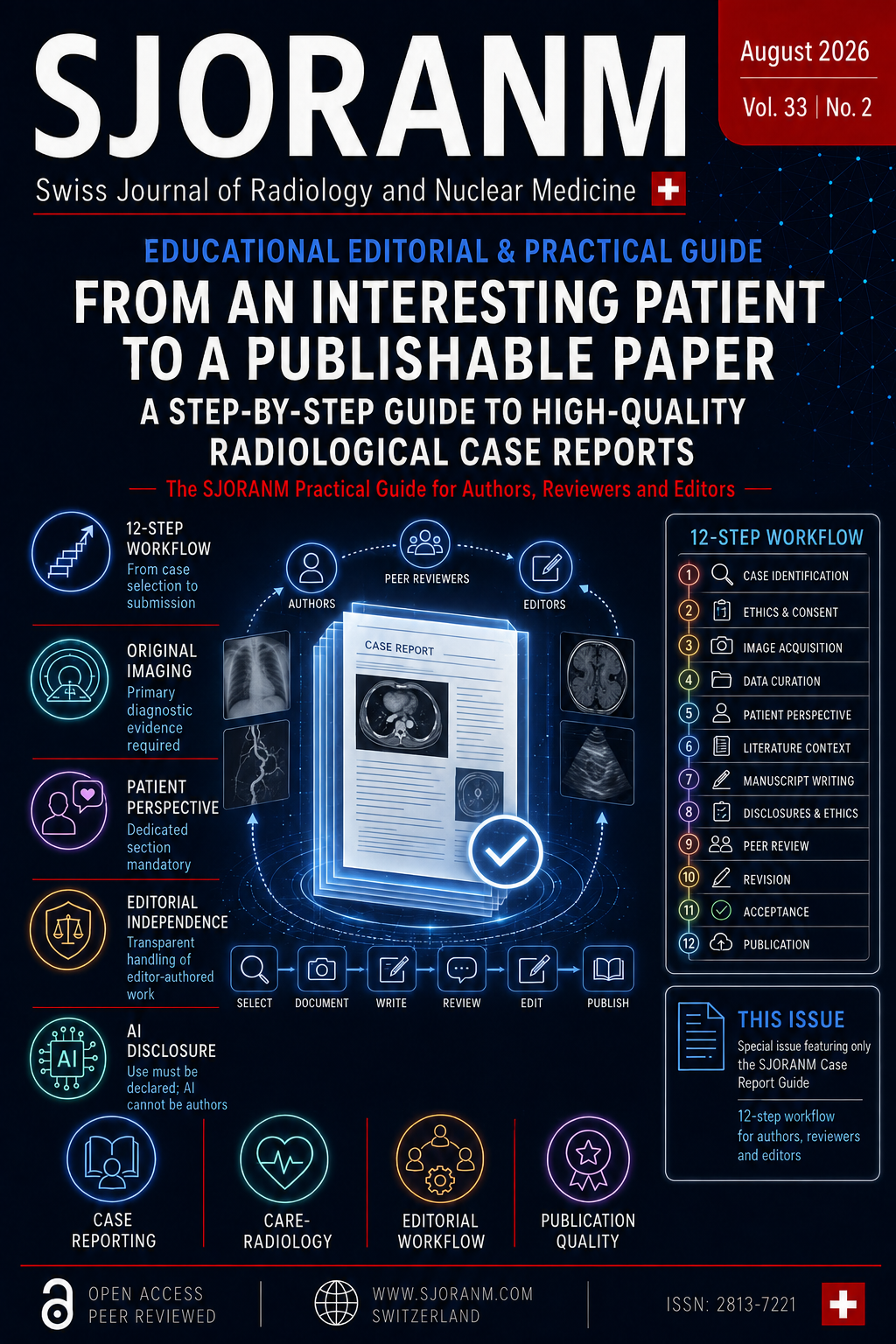
Radiological case reports are most useful when they enable readers to reconstruct the clinical question, inspect the decisive original imaging evidence, follow the diagnostic reasoning, and evaluate how the diagnosis was confirmed and what happened afterwards. CARE-radiology provides the radiology-specific reporting framework. This Educational Editorial & Practical Guide translates CARE-radiology, CARE, ICMJE, COPE, the 2024 Declaration of Helsinki and CRediT into a 12-step SJORANM workflow for authors, reviewers and editors.

SJORANM requires original diagnostic radiological images as primary evidence and a dedicated Patient Perspective section (or a transparent explanation if unobtainable). Pathology is preferred when clinically relevant and available but is not mandatory when another credible reference standard exists. The framework distinguishes external reporting requirements, good scientific practice and journal-specific policy. Accompanying tools include author and reviewer checklists, a technical pre-check, standardised decision-letter modules and a CARE-radiology crosswalk. The aim is an educational, internally consistent and independently verifiable case report before peer review.

Author Biographies

  • Frank Mosler, Department of Diagnostic, Interventional and Pediatric Radiology, Inselspital, University Hospital of Bern, University of Bern, Swiss Journal of Radiology and Nuclear Medicine (SJORANM), Baar, Switzerland

    Board-certified Radiologist & Neuroradiologist; Senior Consultant, Inselspital, Bern University Hospital

    Dr. med. Frank Mosler is a board-certified radiologist and neuroradiologist with more than 30 years of clinical and academic experience across major European university centers. He completed his medical education and early specialty training in radiology and neurosurgery at Charité University Hospital in Berlin. He later specialized in interventional neuroradiology at Alfried Krupp Hospital in Essen, where he also held senior leadership responsibilities.

    His professional career has included academic medicine, diagnostic and interventional radiology, neuroradiology, healthcare management, quality assurance, and scientific publishing in Germany and Switzerland. Since 2017, he has been affiliated with the Department of Diagnostic, Interventional and Pediatric Radiology (DIPR) at Inselspital, Bern University Hospital.

    As Editor-in-Chief of the Swiss Journal of Radiology and Nuclear Medicine, Dr. Mosler leads the journal's editorial and scientific strategy and holds overall responsibility for editorial policy, publication standards, scientific integrity, and final editorial decision-making.

    Institutional affiliation: University Institute of Diagnostic, Interventional and Pediatric Radiology, Inselspital
    Location: Bern, Switzerland
    ROR: 01q9sj412

  • Gerd Nöldge, Department of Diagnostic, Interventional and Pediatric Radiology, Inselspital, University Hospital of Bern, University of Bern

    Founding Editor & Honorary Editor
    Switzerland & Germany
    Senior Consultant Radiology, University Hospitals Heidelberg & Bern

    Prof. Dr. med. Gerd Nöldge is a renowned German radiologist and pioneer in interventional radiology. As former Senior Consultant at Heidelberg University Hospital, he made groundbreaking contributions to gastrointestinal artery embolization, for which he received the inaugural Wilhelm Conrad Röntgen Prize in 1985. He played a key role in advancing kyphoplasty techniques for osteoporotic vertebral fractures, providing long-term evidence for the efficacy and stability of calcium phosphate cement in vertebral body augmentation.

    Prof. Nöldge has also significantly contributed to the clinical development and refinement of transjugular intrahepatic portosystemic shunt (TIPS) procedures, improving outcomes in patients with portal hypertension. His dedication to education and international collaboration has fostered enduring partnerships, including medical exchange programs with leading institutions in China.

    As Founding Editor of the Swiss Journal of Radiology and Nuclear Medicine, Prof. Nöldge played a decisive role in the establishment and early development of SJORANM. His appointment as Honorary Editor recognizes his founding contribution, his longstanding scientific commitment, and his lasting importance to the journal. 

    Former institutional affiliation: University Hospital Heidelberg – Diagnostic and Interventional Radiology
    Location: Heidelberg, Germany & Bern, Switzerland
    ROR: 013czdx64

  • Keivan Daneshvar, Division of Musculoskeletal Radiology, DIPR, Inselspital, Dynamic Imaging Center, Sitem-insel, Bern, Switzerland, University Hospital of Bern, University of Bern

    Senior Consultant of Radiology, Director of Dynamic Imaging Center, Sitem-Insel, Bern

    PD Dr. med. Keivan Daneshvar is a prominent Swiss radiologist and currently serves as Head of the Division of Musculoskeletal Radiology at the University Institute of Diagnostic, Interventional and Pediatric Radiology (DIPR), Inselspital, Bern University Hospital. He also co-leads the Dynamic Imaging Center at sitem-insel, focusing on advanced dynamic and functional musculoskeletal imaging. His clinical expertise centers on musculoskeletal radiology, including MRI/CT/ultrasound of joints, spine, and soft tissues, with special emphasis on sports injuries, degenerative diseases, oncologic MSK imaging, and dynamic/weight-bearing techniques. Dr. Daneshvar has pioneered innovations in AI-assisted diagnostics (e.g., ChatGPT-4.0 for musculoskeletal mass classification and report generation), deep learning reconstruction of accelerated MRI, and multimodal imaging protocols for conditions like diabetic foot, hidradenitis suppurativa, and rotator cuff pathology. As a member of the Editorial Board of the Swiss Journal of Radiology and Nuclear Medicine, he bridges MSK radiology with interventional, pediatric, and nuclear medicine advancements for multidisciplinary musculoskeletal care.

    Institutional affiliation: University Institute of Diagnostic, Interventional and Pediatric Radiology, Inselspital
    Location: Bern, Switzerland
    ROR: 01q9sj412

References

1. Gagnier JJ, Kienle G, Altman DG, Moher D, Sox H, Riley D; CARE Group. The CARE guidelines: consensus-based clinical case report guideline development. J Clin Epidemiol. 2014;67(1):46-51. doi: https://doi.org/10.1016/j.jclinepi.2013.08.003 DOI: https://doi.org/10.1016/j.jclinepi.2013.08.003

2. Riley DS, Barber MS, Kienle GS, Aronson JK, von Schoen-Angerer T, Tugwell P, et al. CARE guidelines for case reports: explanation and elaboration document. J Clin Epidemiol. 2017;89:218-235. doi: https://doi.org/10.1016/j.jclinepi.2017.04.026 DOI: https://doi.org/10.1016/j.jclinepi.2017.04.026

3. Wang M, Luo X, Xiao X, Zhang L, Wang Q, Wang S, et al. CARE-radiology statement explanation and elaboration: reporting guideline for radiological case reports. BMJ Evid Based Med. 2024;29(6):399-408. doi: https://doi.org/10.1136/bmjebm-2023-112695 DOI: https://doi.org/10.1136/bmjebm-2023-112695

4. International Committee of Medical Journal Editors. Recommendations for the Conduct, Reporting, Editing, and Publication of Scholarly Work in Medical Journals. Updated January 2026. Available from: https://www.icmje.org/recommendations/ (accessed 7 August 2026).

5. World Medical Association. Declaration of Helsinki: Ethical Principles for Medical Research Involving Human Participants. 2024 revision. Available from: https://www.wma.net/policies-post/wma-declaration-of-helsinki/ (accessed 7 August 2026).

6. National Information Standards Organization. ANSI/NISO Z39.104-2022, CRediT, Contributor Roles Taxonomy. Baltimore, MD: NISO; 2022. doi: https://doi.org/10.3789/ansi.niso.z39.104-2022 DOI: https://doi.org/10.3789/ansi.niso.z39.104-2022

7. Barbour V, on behalf of the COPE Council. Journals' Best Practices for Ensuring Consent for Publishing Medical Case Reports: Guidance from COPE. December 2016. https://doi.org/10.24318/cope.2019.1.6 DOI: https://doi.org/10.24318/cope.2019.1.6

8. EQUATOR Network. CARE-radiology statement explanation and elaboration: reporting guideline for radiological case reports. Available from: https://www.equator-network.org/reporting-guidelines/care-radiology-statement-explanation-and-elaboration-reporting-guideline-for-radiological-case-reports/ (accessed 7 August 2026).

9. International Committee of Medical Journal Editors. Use of AI by Authors. Updated January 2026. Available from: https://www.icmje.org/recommendations/browse/artificial-intelligence/ai-use-by-authors.html (accessed 7 August 2026).

10. CARE Case Report Guidelines. CARE Checklist. Available from: https://www.care-statement.org/checklist (accessed 7 August 2026).

11. COPE Council. COPE Guidelines: A Short Guide to Ethical Editing for New Editors. Version 3. May 2019. DOI: https://doi.org/10.24318/cope.2019.1.8 DOI: https://doi.org/10.24318/cope.2019.1.8
Downloads

Published

2026-08-23

Data Availability Statement

No new research data were collected for this article.

Issue

Section

Specials

How to Cite

Mosler, F., Nöldge, G., & Daneshvar, K. (2026). From an Interesting Patient to a Publishable Paper: A Step-by-Step Guide to High-Quality Radiological Case Reports. Swiss Journal of Radiology and Nuclear Medicine, 33(2), 1-39. https://doi.org/10.59667/sjoranm.v33i2.14

Share

Similar Articles

1-10 of 104

You may also start an advanced similarity search for this article.

Most read articles by the same author(s)

<< < 1 2 3