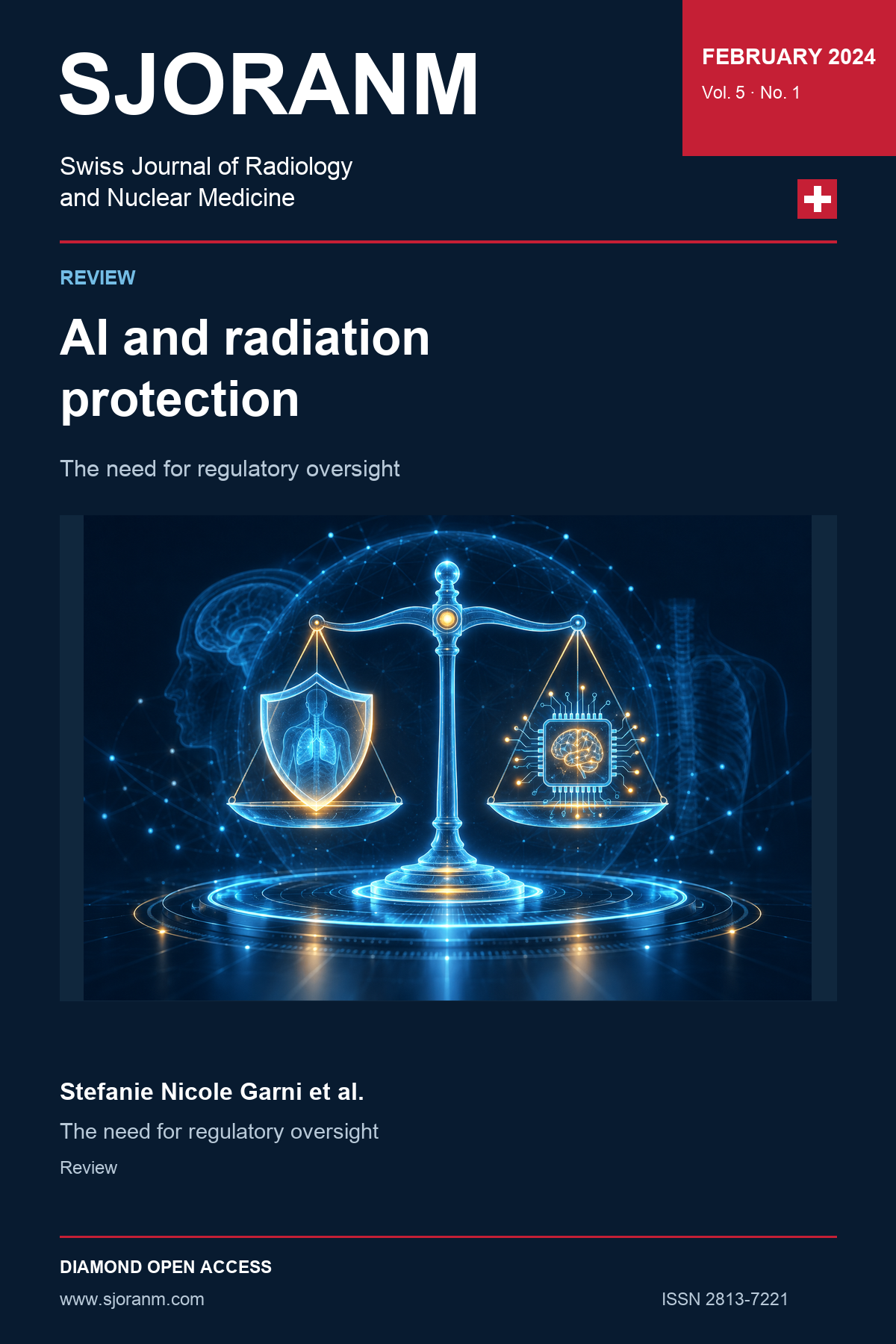
Regulatory Needs for Radiation Protection Devices based upon Artificial Intelligence
State task or leave unregulated?
DOI:
https://doi.org/10.59667/sjoranm.v5i1.11Keywords:
artificial intelligence, radiation protection, regulations, ensuring complianceAbstract
Artificial intelligence (AI) is increasingly employed in radiation protection, encompassing both medical devices and software. These technologies are integrated with AI throughout their manufacturing and application processes. This article underscores the imperative for comprehensive regulation in the utilization of AI. Decisions regarding AI application should not solely rest with manufacturers, medical professionals, or patients. Instead, an overarching "neutral" authority must be engaged to regulate, review, and enforce adherence to established protocols. The authors contend that relying on "self-regulation" within the free market, absent clear guidelines, proves to be inadequately effective and leads to patient's radiation protection safety issues.
References
1. Barreiro-Ares A, Morales-Santiago A, Sendra-Portero F, Souto-Bayarri M. Impact of the rise of artificial intelligence in radiology: what do students think? International Journal of Environmental Research and Public Health 2023; 20(2): 1589. https://doi.org/10.3390/ijerph20021589 DOI: https://doi.org/10.3390/ijerph20021589
2. Bosbach WA, Senge JF, Nemeth B, et al. Ability of ChatGPT to generate competent radiology reports for distal radius fracture by use of RSNA template items and integrated AO classifier. Curr Probl Diagn Radiol. 2024;53(1):102–110. Published online 17 April 2023. https://doi.org/10.1067/j.cpradiol.2023.04.001 DOI: https://doi.org/10.1067/j.cpradiol.2023.04.001
3. Clark P, Kim J, Aphinyanaphongs Y. Marketing and US Food and Drug Administration Clearance of Artificial Intelligence and Machine Learning Enabled Software in and as Medical Devices: A Systematic Review. JAMA Netw Open 2023; 6(7) :e2321792. https://doi.org/10.1001/jamanetworkopen.2023.21792 DOI: https://doi.org/10.1001/jamanetworkopen.2023.21792
4. European Society of R. The role of radiologist in the changing world of healthcare: a White Paper of the European Society of Radiology (ESR). Insights Imaging 2022;13(1):100. https://doi.org/10.1186/s13244-022-01241-4 DOI: https://doi.org/10.1186/s13244-022-01241-4
5. Geis JR, Brady AP, Wu CC, et al. Ethics of artificial intelligence in radiology: summary of the joint European and North American multisociety statement. Radiology 2019; 293(2): 436-440. https://doi.org/10.1148/radiol.2019191586 DOI: https://doi.org/10.1148/radiol.2019191586
6. Giansanti D. The Regulation of Artificial Intelligence in Digital Radiology in the Scientific Literature: A Narrative Review of Reviews. Healthcare: MDPI; 2022:1824. https://www.ncbi.nlm.nih.gov/pmc/articles/PMC9601605/pdf/healthcare-10-01824.pdf DOI: https://doi.org/10.3390/healthcare10101824
7. Jacques T, Fournier L, Zins M, et al. Proposals for the use of artificial intelligence in emergency radiology. Diagnostic and Interventional Imaging 2021;102(2):63-68. https://doi.org/10.1016/j.diii.2020.11.003 DOI: https://doi.org/10.1016/j.diii.2020.11.003
8. Pesapane F, Suter MB, Codari M, Patella F, Volonté C, Sardanelli F. Regulatory issues for artificial intelligence in radiology. Precision medicine for investigators, practitioners and providers: Elsevier; 2020:533-543 (book section). DOI: https://doi.org/10.1016/B978-0-12-819178-1.00052-6
9. Pesapane F, Volonté C, Codari M, Sardanelli F. Artificial intelligence as a medical device in radiology: ethical and regulatory issues in Europe and the United States. Insights into imaging 2018;9:745-753. https://www.ncbi.nlm.nih.gov/pmc/articles/PMC6206380/pdf/13244_2018_Article_645.pdf DOI: https://doi.org/10.1007/s13244-018-0645-y
10. Recht MP, Dewey M, Dreyer K, et al. Integrating artificial intelligence into the clinical practice of radiology: challenges and recommendations. European radiology 2020 ;30: 3576 -3584. https://doi.org/10.1007/s00330-020-06672-5 DOI: https://doi.org/10.1007/s00330-020-06672-5
11. Waymel Q, Badr S, Demondion X, Cotten A, Jacques T. Impact of the rise of artificial intelligence in radiology: what do radiologists think? Diagnostic and interventional imaging 2019;100(6):327-336. https://doi.org/10.1016/j.diii.2019.03.015 DOI: https://doi.org/10.1016/j.diii.2019.03.015
12. US Food & Drug Administration - Good Machine Learning Practice for Medical Device Development: Guiding Principles 2021. Good Machine Learning Practice for Medical Device Development: Guiding Principles. https://www.fda.gov/medical-devices/software-medical-device-samd/good-machine-learning-practice-medical-device-development-guiding-principles
13. Senge, J.F., McMurray, M.T. et al. ChatGPT may free time needed by the interventional radiologist for administration / documentation: A study on the RSNA PICC line reporting template 2023. medRXiv The Preprint Server for Health Sciences. https://doi.org/10.1101/2023.07.14.23292578 DOI: https://doi.org/10.1101/2023.07.14.23292578
14. US Food and Drug Administration. Statement from FDA Commissioner Scott Gottlieb, M.D. on steps toward a new, tailored review framework for artificial intelligence-based medical devices. 2 April 2019. https://www.fda.gov/news-events/press-announcements/statement-fda-commissioner-scott-gottlieb-md-steps-toward-new-tailored-review-framework-artificial
15. US Food and Drug Administration. CDRH Issues Guiding Principles for Predetermined Change Control Plans for Machine Learning-Enabled Medical Devices. 24 October 2023. https://www.fda.gov/medical-devices/medical-devices-news-and-events/cdrh-issues-guiding-principles-predetermined-change-control-plans-machine-learning-enabled-medical
16. US Food and Drug Administration. Marketing Submission Recommendations for a Predetermined Change Control Plan for Artificial Intelligence/Machine Learning-Enabled Device Software Functions; Draft Guidance for Industry and Food and Drug Administration Staff; Availability. Federal Register. 3 April 2023;88:19648–19650. https://www.govinfo.gov/content/pkg/FR-2023-04-03/pdf/2023-06786.pdf
17. Swiss Federal Council. Medical Devices Ordinance of 1 July 2020 (MedDO/MepV), SR 812.213. Version of 1 November 2023. Article 16(2)–(4). https://www.fedlex.admin.ch/eli/cc/2020/552/20231101/de
Downloads
Published
Issue
Section
License
Copyright (c) 2024 Stefanie Nicole Garni, Nando Mertineit, Gerd Nöldge, Keivan Daneshvar; Frank Mosler

This work is licensed under a Creative Commons Attribution 4.0 International License.
This license requires that reusers give credit to the creator. It allows reusers to distribute, remix, adapt, and build upon the material in any medium or format, even for commercial purposes.
 LinkedIn ↗
 X ↗
 VK ↗
 Truth Social ↗
 Bluesky ↗
 YouTube ↗