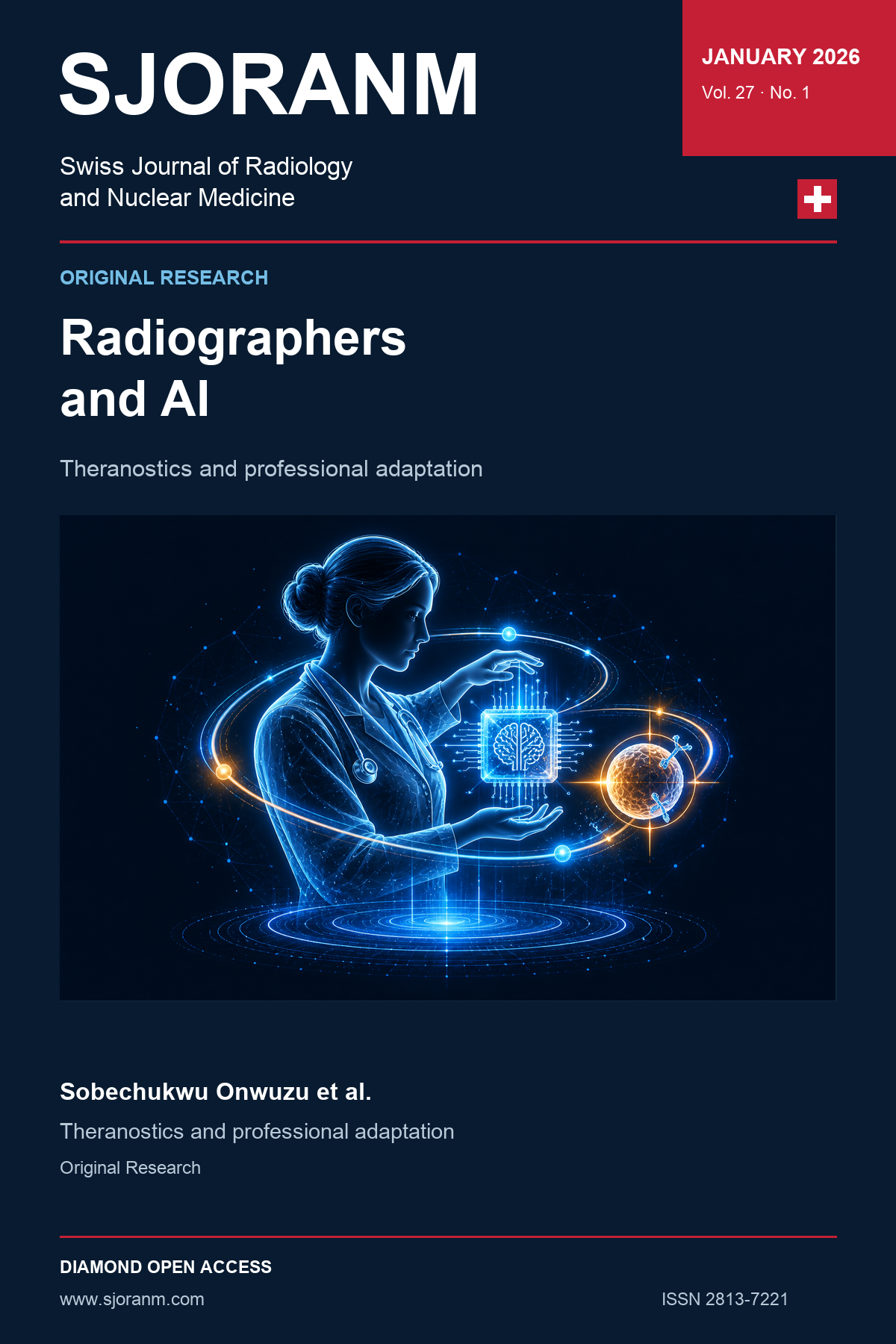
Radiographers’ Perceptions of Artificial Intelligence and Theranostics
Implications for Job Security and Professional Adaptation
DOI:
https://doi.org/10.59667/sjoranm.v27i1.18Keywords:
artificial intelligence, theranostics, Radiography, job security, Professional AdaptationAbstract
Background: Artificial Intelligence (AI) and theranostics are transforming radiographic practice by enhancing diagnostic precision and enabling personalized treatment. However, these innovations raise concerns about professional adaptation and job security.
Objectives: To investigate Nigerian radiographers’ awareness, perceptions, and adaptability regarding these technologies, with a focus on job security and professional relevance.
Method: A cross-sectional survey of 349 Nigerian radiographers assessed awareness, perceptions, and adaptability regarding AI and theranostics. Data were analyzed using descriptive statistics (SPSS v25).
Results: Awareness was higher for AI than theranostics: 31.2% were moderately familiar and 28.7% very familiar with AI, whereas 34.4% were not familiar with theranostics. Most respondents (64.5%) had not attended training or seminars. Regarding possible role displacement through automation, 107 respondents (30.7%) agreed and 35 (10.0%) strongly agreed. Further education or certification attracted agreement from 179 respondents (51.3%) and strong agreement from 79 (22.6%). Adoption as an opportunity for career growth attracted agreement from 168 respondents (48.1%) and strong agreement from 93 (26.6%). Key adaptation factors included mentorship (50.7% in the agree category), financial support (45.6% in the agree category), and curriculum integration (41.5% in the agree category).
Conclusion: Nigerian radiographers demonstrate moderate familiarity with AI but limited understanding of theranostics. While job security concerns persist, willingness to upskill is strong. Structured training, mentorship, and curriculum reform are essential to support professional adaptation and safeguard radiographers’ relevance in the era of AI and theranostics.
Contribution: This study highlights the need for radiography professional bodies and policymakers to prioritize structured training pathways, financial incentives, and cross-disciplinary collaborations to ensure radiographers remain central to technological transitions.
References
1. Baessler B. Artificial intelligence in radiology - Definition, potential and challenges. Praxis (Bern 1994) 2021;110(1):48–53. https://doi.org/10.1024/1661-8157/a003597 DOI: https://doi.org/10.1024/1661-8157/a003597
2. Pinto-Coelho L. How Artificial Intelligence Is Shaping Medical Imaging Technology: A Survey of Innovations and Applications. Bioengineering 2023;10(12):1435. https://doi.org/10.3390/bioengineering10121435 DOI: https://doi.org/10.3390/bioengineering10121435
3. Burkett B., Bartlett D., McGarrah P., Lewis A., Johnson D., Berberoğlu K., et al. A Review of Theranostics: Perspectives on Emerging Approaches and Clinical Advancements. Radiology Imaging Cancer 2023;5(4). https://doi.org/10.1148/rycan.220157 DOI: https://doi.org/10.1148/rycan.220157
4. Akudjedu TN., Torre S., Khine R., Katsifarakis D., Newman D., Malamateniou C. Knowledge, perceptions, and expectations of Artificial intelligence in radiography practice: A global radiography workforce survey. Journal of Medical Imaging and Radiation Sciences 2023;54(1):104–16. https://doi.org/10.1016/j.jmir.2022.11.016 DOI: https://doi.org/10.1016/j.jmir.2022.11.016
5. Stogiannos N., Walsh G., Ohene-Botwe B., McHugh K., Potts B., Tam W., et al. R-AI-diographers: a European survey on perceived impact of AI on professional identity, careers, and radiographers’ roles. Insights Imaging 2025;16(1):43. https://doi.org/10.1186/s13244-025-01918-6 DOI: https://doi.org/10.1186/s13244-025-01918-6
6. Chivandire G., Mudadi L., Chinene B. Radiographers’ Perspectives on the Impact of Artificial Intelligence use on their future roles: A Qualitative Study. Mjz 2023;49(3):263–72. https://doi.org/10.55320/mjz.49.3.363 DOI: https://doi.org/10.55320/mjz.49.3.363
7. Aldhafeeri FM. Perspectives of radiographers on the emergence of artificial intelligence in diagnostic imaging in Saudi Arabia. Insights into Imaging 2022;13(1):178. https://doi.org/10.1186/s13244-022-01319-z DOI: https://doi.org/10.1186/s13244-022-01319-z
8. Al Mohammad B., Aldaradkeh A., Gharaibeh M., Reed W. Assessing radiologists’ and radiographers’ perceptions on artificial intelligence integration: opportunities and challenges. British Journal of Radiology 2024;97(1156):763–9. https://doi.org/10.1093/bjr/tqae022 DOI: https://doi.org/10.1093/bjr/tqae022
9. Ezeaka, NB. Artificial Intelligence (AI) and Health Communication Policy in Nigeria: Challenges and Prospects. Journal of Advanced Research and Multidisciplinary Studies 2024;4(4):141–9. https://doi.org/10.52589/JARMS-ARD2E2R4 DOI: https://doi.org/10.52589/JARMS-ARD2E2R4
10. Ogolodom MP., Daniel Ochong A., Brownson Egop E., Ugwem Jeremiah C., Kenneth Madume A., Nyenke CU., et al. Knowledge and perception of healthcare workers towards the adoption of artificial intelligence in healthcare service delivery in Nigeria. AG Salud 2023;1:16. https://doi.org/10.62486/agsalud202316 DOI: https://doi.org/10.62486/agsalud202316
11. Oguche DE., Dimka BT., Godwin T., Mallo Jr S., Mangai MJ., Oguche S. AI-Driven Health Applications in Africa: A Structured Literature Review with a Focus on Nigeria. IJRIAS 2025;X(VI):596–606. https://doi.org/10.51584/IJRIAS.2025.10060044 DOI: https://doi.org/10.51584/IJRIAS.2025.10060044
12. Shittu RA., Ahmadu J., Famoti O., Nzeako G., Ezechi ON., Paul-Mikki Ewim C., et al. Policy Frameworks for Artificial Intelligence Adoption: Strategies for Successful Implementation in Nigeria. IJSSER 2024;3(6):105–16. https://doi.org/10.54660/IJSSER.2024.3.6.105-116 DOI: https://doi.org/10.54660/IJSSER.2024.3.6.105-116
13. Al-Ibraheem A. Theranostics in Developing Countries: Addressing Challenges and Potentials from Training to Practice. World J Nucl Med 2023;22(03):171–3. https://doi.org/10.1055/s-0043-1774733 DOI: https://doi.org/10.1055/s-0043-1774733
14. Brink A., Cerci JJ., Giammarile F., Yurystovskyi D., Korde A., Estrada-Lobato E., et al. Global Challenges in the Provision of Theranostic Services the International Atomic Energy Agency (IAEA) Perspective. World J Nucl Med 2025:s-0045-1807251. https://doi.org/10.1055/s-0045-1807251 DOI: https://doi.org/10.1055/s-0045-1807251
15. Abuzaid MM., Elshami W., Tekin H., Issa B. Assessment of the Willingness of Radiologists and Radiographers to Accept the Integration of Artificial Intelligence Into Radiology Practice. Academic Radiology 2022;29(1):87–94. https://doi.org/10.1016/j.acra.2020.09.014 DOI: https://doi.org/10.1016/j.acra.2020.09.014
16. Antwi WK., Akudjedu TN., Botwe BO. Artificial intelligence in medical imaging practice in Africa: a qualitative content analysis study of radiographers’ perspectives. Insights Imaging 2021;12(1):80. https://doi.org/10.1186/s13244-021-01028-z DOI: https://doi.org/10.1186/s13244-021-01028-z
17. Arkoh S., Akudjedu TN., Amedu C., Antwi WK., Elshami W., Ohene-Botwe B. Current Radiology workforce perspective on the integration of artificial intelligence in clinical practice: A systematic review. Journal of Medical Imaging and Radiation Sciences 2025;56(1):101769. https://doi.org/10.1016/j.jmir.2024.101769 DOI: https://doi.org/10.1016/j.jmir.2024.101769
18. Chen Y., Stavropoulou C., Narasinkan R., Baker A., Scarbrough H. Professionals’ responses to the introduction of AI innovations in radiology and their implications for future adoption: a qualitative study. BMC Health Serv Res 2021;21(1):813. https://doi.org/10.1186/s12913-021-06861-y DOI: https://doi.org/10.1186/s12913-021-06861-y
19. Sharip H., Che Zakaria WFW., Leong SS., Ali Masoud M., Mohd Junaidi MZH. Radiographers’ Acceptance on the Integration of Artificial Intelligence into Medical Imaging Practice. E-BPJ 2023;8(25):255–60. https://doi.org/10.21834/e-bpj.v8i25.4872 DOI: https://doi.org/10.21834/e-bpj.v8i25.4872
20. Meyer J. The Adoption of New Technologies and the Age Structure of the Workforce. SSRN Journal 2008. https://doi.org/10.2139/ssrn.1210162 DOI: https://doi.org/10.2139/ssrn.1210162
21. Tariq K., Tahir H., Malik U., Iqbal K., Shabbir A., Hassan AU. Attitudes and readiness to adopt artificial intelligence among healthcare practitioners in Pakistan’s resource-limited settings. BMC Health Services Research 2025;25(1):1031. https://doi.org/10.1186/s12913-025-13207-5 DOI: https://doi.org/10.1186/s12913-025-13207-5
22. Dai Q., Li M., Yang M., Shi S., Wang Z., Liao J., et al. Attitudes, Perceptions, and Factors Influencing the Adoption of AI in Health Care Among Medical Staff: Nationwide Cross-Sectional Survey Study. J Med Internet Res 2025;27:e75343. https://doi.org/10.2196/75343 DOI: https://doi.org/10.2196/75343
23. Bredella MA., Fessell D., Thrall JH. Mentorship in academic radiology: why it matters. Insights into Imaging 2019;10(1):107. https://doi.org/10.1186/s13244-019-0799-2 DOI: https://doi.org/10.1186/s13244-019-0799-2
24. Bwanga O. Barriers to Continuing Professional Development (CPD) in Radiography: A Review of Literature from Africa. Health Professions Education 2020;6(4):472–80. https://doi.org/10.1016/j.hpe.2020.09.002 DOI: https://doi.org/10.1016/j.hpe.2020.09.002
25. Elechi US., Adeoye AF., Obiya SO., Umar SA., Ezeamii VC., Iwu P., et al. Digital Transformation in Radiography Practice in Nigeria: A Comprehensive Review. Journal of Medical Science, Biology, and Chemistry 2025;2(1):92–103. https://doi.org/10.69739/jmsbc.v2i1.562 DOI: https://doi.org/10.69739/jmsbc.v2i1.562
Downloads
Published
Data Availability Statement
Data required for this study may be made available by the author(s) upon reasonable request.
Issue
Section
License
Copyright (c) 2026 Onwuzu Sobechukwu W.I., Uche-Nwankwo Adanna Munachimsoaga, Ozoamalu Chinemerem Sebastian, Ozohili Chikaosolu Vanessa, Peter-Adim Ezinne Stacey, Solomon Prisca Chinecherem, Sopuluchukwu Precious Ogechi, Ikechukwu Onwunta Emmanuel

This work is licensed under a Creative Commons Attribution 4.0 International License.
This license requires that reusers give credit to the creator. It allows reusers to distribute, remix, adapt, and build upon the material in any medium or format, even for commercial purposes.
 LinkedIn ↗
 X ↗
 VK ↗
 Truth Social ↗
 Bluesky ↗
 YouTube ↗